
Using a mind map to overcome a negative bias toward new ideas
Nov 19th, 2009 | By Chuck Frey | Category: Tips & Techniques
Most people, when faced with a new idea, find it easy to identify things that are wrong about it or reasons why it won’t work. Psychologists call this a negative bias, and it seems to be hard-wired into our human brains. A survival mechanism left over from our caveman days, perhaps?
The problem with negative bias in the modern world is that it causes us to kill new ideas far too quickly. To balance this tendency, we need to get in the habit of asking ourselves questions with a positive bias, like these:
- What is good about this idea?
- What is amazing about this idea?
- What is potentially beneficial about this idea?
This is much harder than criticizing a new idea, but it is time well spent, because it often helps us to identify things that are truly remarkable about the new idea – and can mentally predispose us to give it the attention and consideration it deserves.
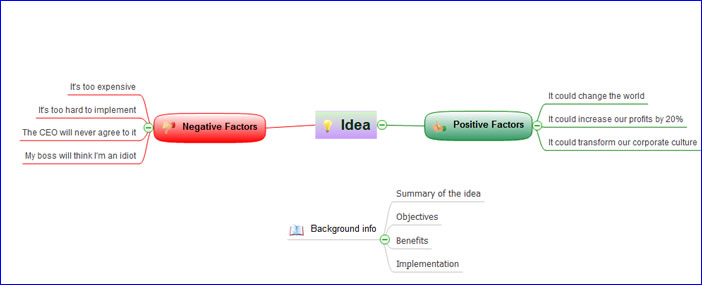
As I was thinking about this process, it occurred to me that a mind map is an ideal way to evaluate our ideas in a fair and balanced way. Positive and negative factors can be placed opposite of each other and the central topic, helping us to visualize the positive and negative forces acting upon the idea. Here’s how to create such a map (click on the image above to view a larger version):
- For the central topic of the map, describe the idea in a few words.
- Create a new subtopic and name it “negative factors.” If necessary, drag it to the left side of the main topic.
- With this topic still selected, begin to create subtopics that briefly describe each of the reasons why this new idea potentially won’t work. Invest at least five minutes describing these factors.
- Select the central topic of your map and create a second subtopic entitled “positive factors.” If necessary, drag it to the right side of the central topic. Your map should now resemble a “tug-of-war” between positive and negative factors.
- Spend at least 5 to 10 minutes brainstorming why this new idea could potentially work, using the questions outlined above. One way to identify these positive factors is to take a negative factor and reverse it. Another useful way is to think about a negative factor and to ask yourself, “What would the effect be if this constraining factor was eliminated or didn’t exist?” What we’re trying to do here is to envision how your idea would perform if this negative factor was minimized or completely eliminated.
- If you find that this whole process is a little bit too abstract for you, you may want to consider creating a floating topic in which you deconstruct the idea in as much detail as possible. Use as many levels of topics and subtopics as needed in order to fully describe the idea. For best results, I recommend that you position this branch directly above or directly below the central topic, so it does not interfere with the “tug-of-war” between the positive and negative factors. You can then use the content of this part of your map as inspiration for brainstorming the positive and negative factors.
One other potential embellishment: Color the positive factors topic and all of its subtopics green, to emphasize their positive focus, and recolor the text and lines for the negative factors to red, to emphasize their negative nature. If you choose to add a branch for background information about the idea, this can remain black to emphasize that it represents supporting information.
The next time you need to think about a new idea in a balanced way, why not give this technique a try?
Popularity: 4% [?]


These are great tips. I hope you don’t mind if I offer some builds.
A brainstorming technique called Synectics uses “I wish…” and “How to…” statements to circumvent opposition to new ideas. So if a proposed idea is rejected as too expensive to implement, then rephrase the concern as “I wish this could be done cheaply” or “How to make this affordable to everyone.” These restatements help lead to true innovations. As John Prince (son of Synectics founder) once told me: “It’s easier to make a dangerous idea practical than to make a practical idea different.”
Here’s a good overview of the Synectics brainstorming technique:
http://creatingminds.org/articles/synectics.htm
I also wrote about this very topic — overcoming negative bias toward new ideas — as it relates to presenting new candidate brand names to clients (which is what I do — I name things).
The three techniques I suggest:
- Repetition: Repeat a name out loud at least 3 times so it begins to feel familiar;
- Analogy: Show how analogous existing brand names (in meaning or style) have already been used successfully by other companies;
- Context: Present names in a credible, real-world context (like a package or business card) so it feels less speculative and abstract.
If you’re interested in reading more about this — including the vexing “Zajonc Effect” — here’s the link to my article “Instinct As Enemy: How to Sell-in the New and Unfamiliar.”
http://operativewords.blogspot.com/2009/06/instinct-as-enemy-how-to-sell-in-new.html
Thanks for your post.
- Anth
This is great advice for it puts you in the position to visual the positive and negatives that you’ve assumed to be in regards to any topic of choice, especially the negative because it puts you in a position to break down your assumptions and thus see what really is a logical fear based or problem needing to be solved issue.
I think this map format would also work well by breaking down the negative side into a critical and creative sub form as well, thus giving you the visual of what negatives are critical and what negatives may be a creativity issue, because sometimes negative aspects are not critical rather, creative negatives perhaps not enough brainstorming has been initiated or you need outside support to make the negative that you’ve listed that it’s not critical rather creative, thus there’s always room to decipher that information.
In the end, if you lay it out on the table and get a visual view, you can break out of those negative habits.
Great post.
of course SWOT analysis has been used within a MM for years – it is another term for positive and negative factors (positive – strengths, opportunities, negative – weaknesses, threats
Edward de Bono has a couple of tools that is very similar to this.
The first is called PMI: Plus, Minus, Interesting.
He recommends first listing all the positive aspects of the topic; usually for a set time period. Then listing all the minuses. Then, all the interesting points, without a judgment as to positive or negative.
I think the difference is in the method. Our tendency would be to think about a topic, and when an idea pops into our heads, to “categorize” it as either positive or negative. De Bono suggests the discipline of focusing on one aspect at a time, such as “positive”, then scanning everything in that direction.
The other tool is called Six Thinking Hats. Where each hat type (color) represents a different thinking style. So for example, you might “put on” the white hat to think of the objective facts of a topic. Then the black hat to do some critical (logical negative) thinking. Then the yellow hat to think in terms of the logical positive, or optimistic aspects.
I have a couple of mind maps of these, if I knew how to upload them.
Jim
For me it’s about tapping into our thought processes; thus I use the T.A.P process.
Have a look.
http://1.bp.blogspot.com/_wDTEtyoR2Uk/SneDDs05OAI/AAAAAAAAAIs/WYu8P1wp5xc/s1600/Using%2Bthe%2BT.A.P%2Bprocess.png
I can identify maybe 4 people I enjoy working with because they are great listeners and they truly accept different perspectives with respect. When I work with these folks I don’t need any mind mapping, etc….. just an observation…. Billk