Elevate your thinking and accelerate your results with visual thinking tools



You’re consuming 174 newspapers worth of information every single day.
Your calendar is packed with meetings. Your inbox won’t stop. Your documents folder is a graveyard of ideas you can’t find. And AI just made everything 10x worse—ChatGPT can generate more content in 30 seconds than you could read in a week.
Meanwhile, you’re still using tools designed in 1983.
 Word documents. PowerPoint slides. Excel spreadsheets. Linear tools that force you to see one idea at a time, like trying to understand an entire forest while staring at a single tree trunk, five feet away.
No wonder you feel like you’re drowning.
But here’s what nobody’s telling you:
The problem isn’t the volume of information. The problem is your tools can’t handle it.
And while you’re drowning, there’s a group of professionals who aren’t. They’re crystal clear. Their ideas get heard first. Their presentations are memorable. Their projects actually get done. They stand out in every meeting, every proposal, every pitch.
What’s their secret?
They stopped trying to think in lines and started thinking in space.
They adopted visual thinking tools. Now they have a competitive edge you can see.
 Let’s be brutally honest about where this is heading:
 Your ideas stay invisible while colleagues who think visually get promoted
You waste 10+ hours every week searching through endless documents for information you already have
AI makes everyone’s content generic. You become replaceable noise
Decision paralysis kills your productivity because you can’t see your options
Your team stays misaligned because they literally cannot see what you see
You spend hours preparing presentations that people forget 10 minutes later
Stakeholders tune you out because you’re explaining complexity the same way everyone else does
Here’s the hard truth:
In the age of AI, clarity is the new currency.
When everyone can generate content, the people who can make sense of it—who can see patterns, show connections, and communicate visually—become invaluable.
Everyone else becomes replaceable.
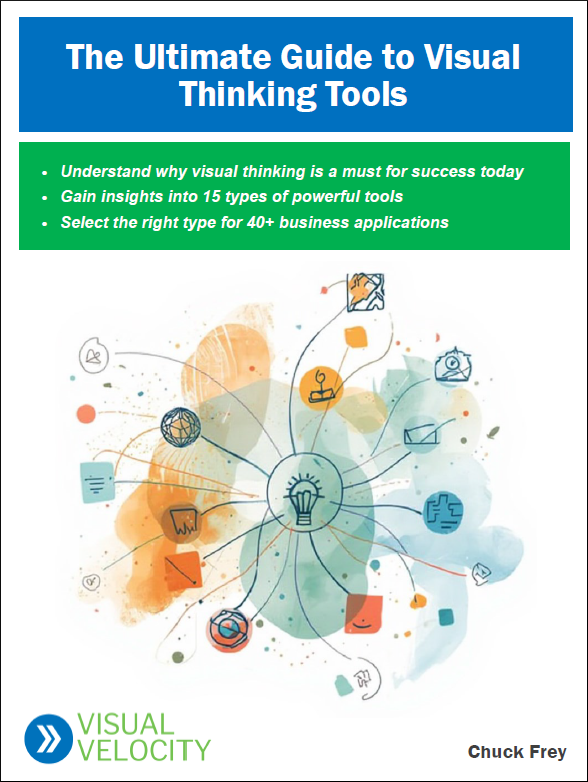 The Ultimate Guide to Visual Thinking Tools isn’t another software listicle or theory-heavy textbook.
It’s your complete blueprint for thinking clearly, creating powerfully, and communicating in ways that make people actually listen—even when they’re drowning in information.
Inside, you’ll discover:
 15 battle-tested visual thinking tool categories (from mind mapping to visual AI) with exactly when and how to use each one
The decision matrix system that matches YOUR specific work challenges to the RIGHT tools—so you never waste time on the wrong software
42 real-world applications with step-by-step implementation strategies you can use today
Detailed advantages and disadvantages for every tool category (based on 15 years of hands-on experience, not marketing hype)
A quick-start framework that take you from confused to productive in one lunch break
83 specific tool recommendations across free and paid options (so you know exactly where to start)
This isn’t about learning every visual tool. It’s about building YOUR personal visual thinking stack: the 2-3 tools that transform how you work, starting this week.
 Within 7 days:
You’ll implement your first visual tool and save 2+ hours that week
Your next presentation will make people sit up and pay attention
You’ll see connections in your work you couldn’t see before
Within 30 days:
You’ll cut meeting prep time by 50% using visual agendas and roadmaps
Your stakeholders will say “yes” faster because they finally see your vision
You’ll make decisions 3x quicker by visualizing all your options at once
Your team will stop asking “what are we doing?” because it’s visually clear
Within 90 days:
You’ll have a “second brain” that captures, connects, and retrieves every important idea
You’ll stand out in every meeting as the person who brings clarity
You’ll build your reputation as someone who “just gets it” and makes complex things simple
You’ll wonder how you ever worked without visual thinking tools
Bottom line: You’ll become the person others look to when chaos needs clarity—and that’s a competitive advantage AI can’t replace.
Each category of visual thinking tool includes:
✓ Detailed overview of how the tool works
✓ Recommended applications with real examples
✓ Complete advantages and disadvantages
✓ Specific tool recommendations (free and paid)
✓ Quick implementation tips from 15 years of experience
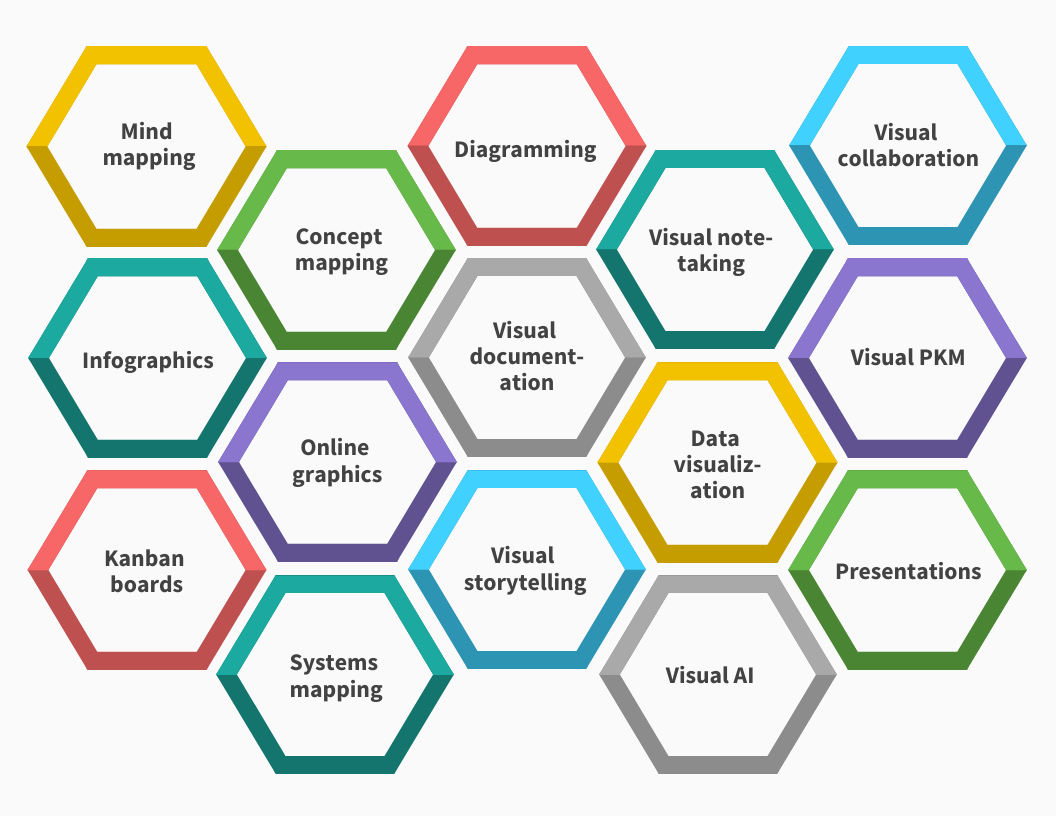
Category 1: Mind Mapping
Transform brainstorming from random lists to connected idea networks
Best for: Strategic planning, project design, content creation, problem-solving
Category 2: Diagramming
Document processes and systems with professional clarity
Best for: Workflow mapping, technical documentation, org charts, decision trees
Category 3: Visual Collaboration
Turn virtual meetings into productive sessions where everyone contributes
Best for: Remote brainstorming, design thinking, sprint planning, workshops
Category 4: Concept Mapping
Show complex relationships and dependencies that linear tools can’t capture
Best for: Knowledge management, research synthesis, systems analysis, risk mapping
Category 5: Visual Note-Taking
Never lose an important idea again
Best for: Meeting notes, research documentation, learning, knowledge capture
Category 6: Infographics
Transform boring data into compelling visual stories
Best for: Marketing campaigns, reports, training materials, social media
Category 7: Visual Documentation
Build knowledge bases people actually use
Best for: SOPs, product docs, team wikis, onboarding guides
Category 8: Visual Personal Knowledge Management
Create your “second brain” that grows smarter over time
Best for: Research synthesis, expertise mapping, long-term learning
Category 9: Online Graphics
Design professional visuals without being a designer
Best for: Social media, presentations, marketing materials, brand assets
Category 10: Data Visualization
Turn spreadsheets into insights that drive decisions
Best for: Business intelligence, performance tracking, reporting, analytics
Category 11: Kanban Boards
See exactly where work stands and where bottlenecks hide
Best for: Project management, content workflows, sales pipelines, task tracking
Category 12: Visual Storytelling
Create narratives that people remember and act on
Best for: Marketing campaigns, case studies, training, change management
Category 13: Presentations
Stop boring people with bullet points
Best for: Sales pitches, conference talks, board meetings, client proposals
Category 14: Systems Mapping
Understand and optimize complex organizational systems
Best for: Strategic planning, process improvement, change management, stakeholder analysis
Category 15: Visual AI
Leverage AI to generate, structure, and enhance visual thinking
Best for: Rapid research synthesis, content creation, strategy exploration
PLUS: The Visual Thinking Tool Selection Matrix
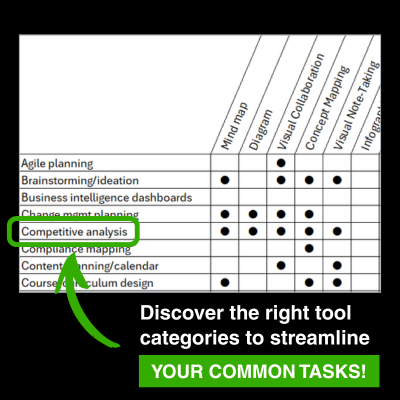
A comprehensive decision framework mapping 42 common business challenges to the most effective tool categories—your roadmap to building the perfect visual thinking stack for YOUR specific needs.
 I’ve spent 18 years immersed in the world of visual thinking tools, not as a casual observer, but as someone who lives and breathes this stuff daily.
I’m the founder and publisher of Visual Velocity (formerly Mind Mapping Software Blog), where I’ve:
Tested and reviewed 100+ visual thinking tools
Published 500+ in-depth articles and guides
Interviewed 50+ tool developers and visual thinking experts
Helped 50,000+ professionals discover the right tools for their needs
I’m not a theorist teaching from textbooks. I’m a practitioner showing you what actually works when you’re drowning in real-world complexity.
I’ve personally used visual thinking tools to:
Plan and launch multiple digital products
Manage complex multi-stakeholder projects
Create hundreds of pieces of content
Build and maintain knowledge systems that compound value over years
This guide contains everything I wish someone had told me 18 years ago, distilled into a decision framework that will save you hundreds of hours of trial and error.
 Here’s Everything You Get:
📘 The Ultimate Guide to Visual Thinking Tools (62-page comprehensive guide)
15 detailed tool category profiles
42 application frameworks
83 specific tool recommendations
The Visual Thinking Tool Selection Matrix
Quick-start implementation guides
🎁 FREE BONUS: Tool selection matrix that will help you select the tools that are the best match for your needs.
You have two paths forward:
 Path 1: Keep doing what you’re doing
Keep drowning in information
Keep using tools designed 40 years ago
Keep wasting hours searching for information you know you have
Keep blending into the AI-generated noise
Keep hoping someone notices your good ideas
Path 2: Master visual thinking and transform your career
Think with crystal clarity while others drown
Communicate with undeniable impact
Make decisions 3x faster
Stand out in every meeting, presentation, and proposal
Build a second brain that makes you permanently more effective
Become the person others look to when chaos needs clarity
The leaders who thrive in the next decade will be those who can make sense of complexity, communicate with impact, and generate ideas others can’t see.
Visual thinking tools are your accelerator to get there.
Your competitive edge begins the moment you go visual.