

A strategic companion for clarity, trust and transformation
In today’s hyper-competitive business landscape, consultants and coaches are no longer measured solely by the quality of their expertise—they are measured by how quickly, clearly, and impactfully they can translate that expertise into results.
Clients expect clarity in minutes, not hours; actionable strategies in days, not weeks. The margin for error is razor-thin, and the demand for precision, creativity, and adaptability has never been higher.
The pressures consultants and trainers face today
Information Overload: Insights, data points and stakeholder inputs arrive from multiple channels, often in unstructured formats. Sifting through and synthesizing this noise into a coherent picture drains valuable time and focus.
Accelerated Timelines: Project lifecycles have shortened dramatically. Strategic clarity and execution plans are expected almost immediately, leaving little room for deep reflection or iterative planning.
Stakeholder Complexity: Consultants must align competing priorities and perspectives across departments, cultures and sometimes continents, each with its own agenda and vocabulary.
Training Retention & Engagement: For trainers, the battle is not just to transfer knowledge, but to ensure it sticks. In an age of digital distractions, keeping learners engaged, active and able to apply new concepts has become a science in itself.
Hybrid & Remote Dynamics: Many sessions now take place in hybrid or fully remote formats. This raises the bar for designing experiences that are interactive, personalized and equally effective across physical and digital spaces.
Why mind mapping is a game-changer
These pressures require a method that cuts through complexity without sacrificing depth—a system that transforms scattered information into a shared, actionable vision. Mind mapping in consulting and coaching delivers exactly that.
- Rapid synthesis of complex information, turning fragmented data into a clear strategic picture.
- Stronger collaboration, ensuring every participant sees not only their role but how it connects to the bigger mission.
- Higher retention rates in training environments, as visual structures support memory and comprehension.
- Adaptability, with maps that can be updated, reshaped, and expanded in real time to match evolving goals.
Core applications of mind mapping in consulting and coaching
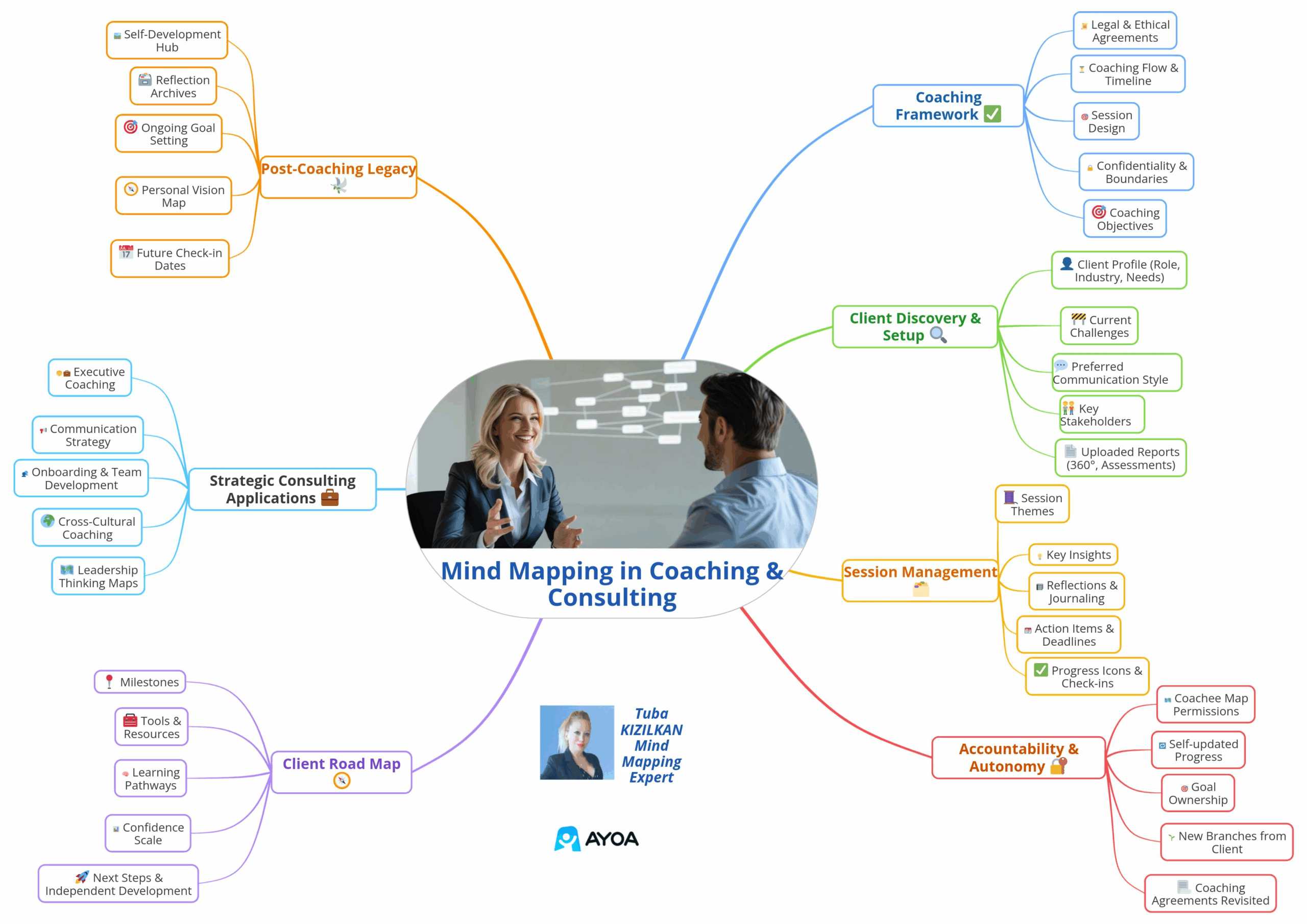
I have developed a practical, field-tested approach to integrating mind mapping into coaching and consulting processes. This is illustrated in my Mind Mapping in Consulting & Coaching mind map, which shows how structured visual thinking supports every stage of the process:
- Coaching Framework: Clear legal and ethical agreements, session flow, confidentiality boundaries and defined objectives.
- Client Discovery & Setup: Understanding client profiles, challenges, preferred communication styles and key stakeholders.
- Session Management: Structuring themes, capturing key insights, setting SMART goals and ensuring follow-through.
- Accountability & Autonomy: Encouraging ownership, tracking progress and enabling clients to update their own maps.
- Client Road Map: Outlining milestones, resources, learning pathways and next steps.
- Strategic Consulting Applications: From executive coaching to cross-cultural strategy, onboarding, and leadership mapping.
- Post-Coaching Legacy: Creating a self-development hub with reflection archives, future goals, and a vision map.
This mind map serves as a structured overview of how coaches and consultants can integrate mind mapping into their practice. It covers everything from the coaching framework and client discovery to session management, strategic consulting and long-term development. It is not just a tool, but a reflection of the mindset I bring into every professional collaboration.
Tuba Kızılkan is a mind mapping coach and business English strategist.
Leave a Reply