

Most people think the hard part of a mind map is filling it in. It isn’t. The decisions that matter most happen in the first two minutes, when you choose your first-level topics. Everything you add afterward hangs from those few branches.
That’s why a weak foundation is so sneaky. It doesn’t announce itself. Your map looks fine at five branches and a dozen subtopics. The cracks only show up later, when you’ve invested an hour of thinking, added 50 ideas and shared the map with your team. By then, fixing it costs far more than getting it right would have.
Tony Buzan called first-level topics “basic ordering ideas” and compared them to the chapters of a book. It’s a good analogy, and here’s an even more practical one: they’re the foundation of a house. Nobody admires a foundation. But pour it carelessly, and every wall, window and roof beam you add later inherits the problem.
The three costs of a weak foundation
1. Blind spots: what doesn’t fit becomes invisible
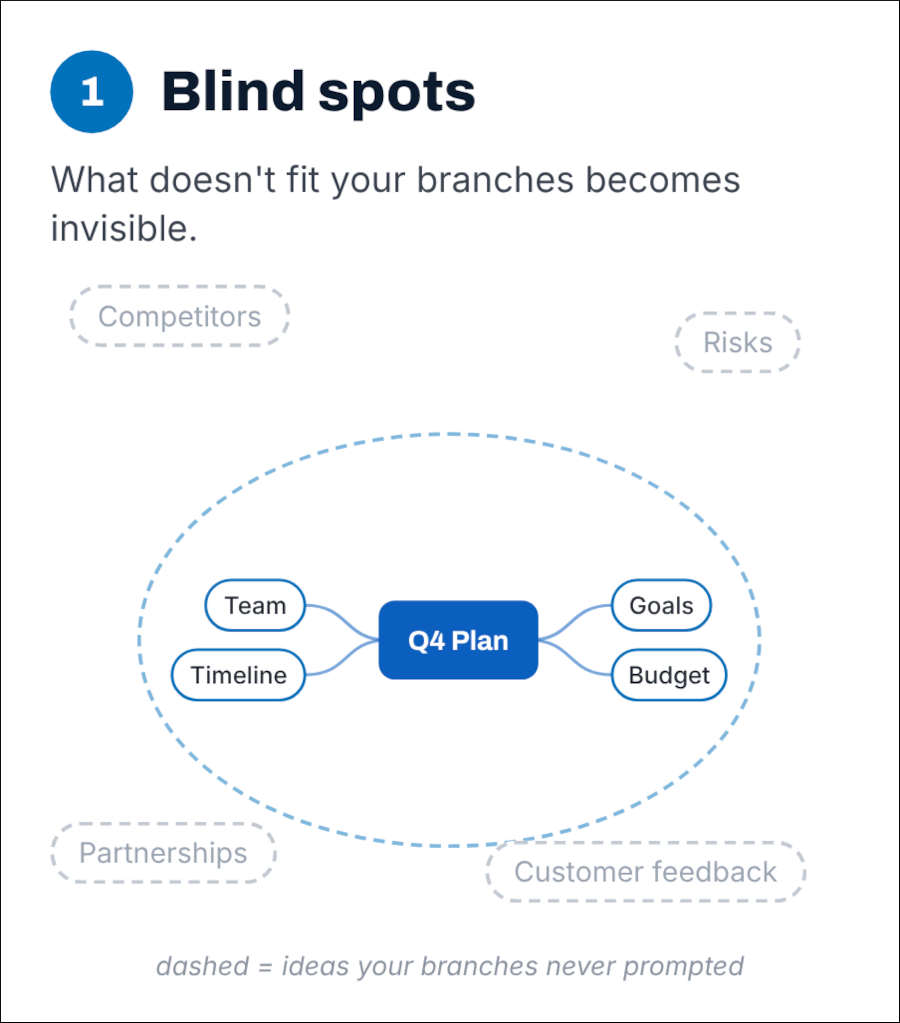
Your first-level topics define your map’s scope. They also limit it. Once those branches are on the screen, your brain starts sorting every new idea into them, and ideas that don’t fit quietly disappear.
Picture a quarterly plan built on goals, budget, timeline and team. It looks complete. But where do competitors go? Customer feedback? Risks? There’s no branch for them, so they never come up. The map didn’t just fail to capture those ideas. It kept you from thinking of them.
That’s the most dangerous cost, because you can’t see it. A gap in a plan rarely looks like a gap. It looks like a finished map.
2. A map others can’t follow
A mind map is often a communication tool. You share it in a meeting, send it to a client or hand it to a colleague. That’s when a weak foundation gets exposed.
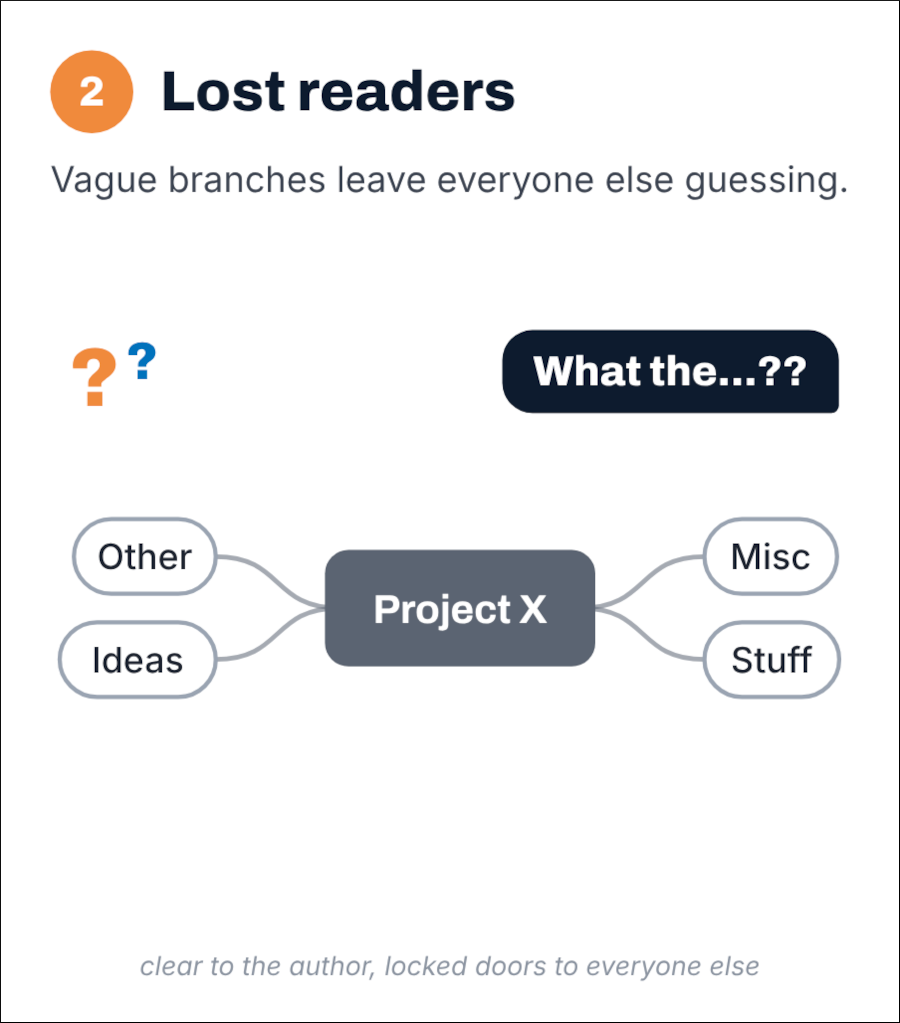
Branches labeled “Misc,” “Stuff” or “Ideas” made perfect sense to you when you created them. To everyone else, they’re locked doors. I’ve seen countless maps where the author clearly understood what he or she meant, and the rest of us were left scratching our heads and going “What the…??”
When readers can’t find their way around your map, they stop trusting it. Then they ask you to “just put it in a document,” and the clarity you worked for is lost.
3. The restructuring tax
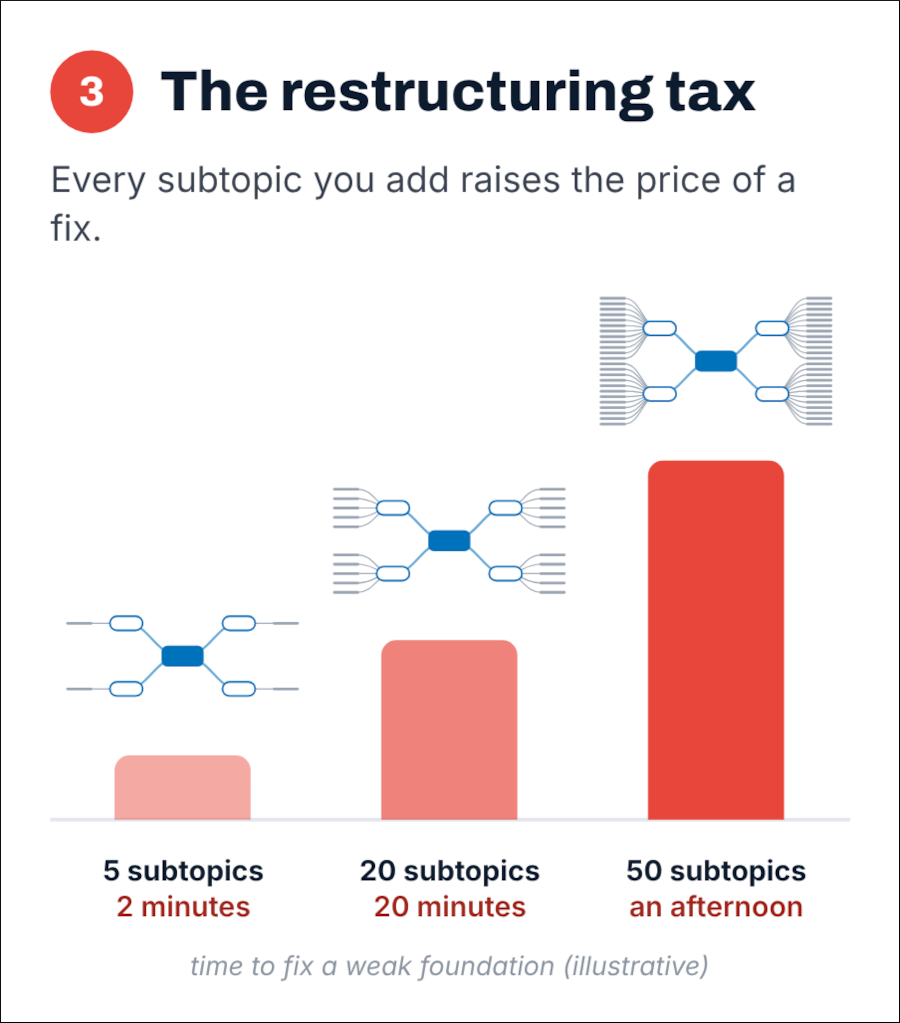
Every subtopic you add to a weak foundation raises the price of fixing it.
At five subtopics, rethinking your first-level topics takes a couple of minutes. At 20, it might take 20 minutes. At 50, you’re looking at an afternoon of dragging branches, re-reading notes and trying to remember why you put things where you did. Many people never pay that tax. They live with a map that doesn’t work, or they abandon it altogether.
The numbers above are illustrative, not measured, but anyone who has restructured a large map knows the shape of that curve. It only goes one direction.
Why the costs compound
These three costs feed each other. A blind spot leaves a gap. You notice it after you’ve added 50 subtopics, so filling it means paying the restructuring tax. You put it off, wedge the missing ideas into whatever branch is closest, and your map gets harder for anyone else to follow. Before long, even you don’t trust it.
That’s why a weak foundation rarely fails dramatically. It erodes your map slowly, until the day you open it and decide it’s easier to start over in a Word document.
Warning signs your foundation is cracking:
- Your “Miscellaneous” branch keeps growing. It’s a parking lot that has turned into a junk drawer, and it’s usually hiding a first-level topic you haven’t named yet.
- Ideas keep fitting under two branches. Two of your first-level topics probably overlap and need to be combined or redefined.
- One branch has swallowed the map. It likely holds several topics that deserve branches of their own.
- New ideas have no obvious home. Your foundation is too narrow for the subject.
- You can’t explain the map in 60 seconds. If you can’t walk someone through your first-level topics quickly, they won’t be able to follow them either.
The two-minute foundation check
The cheapest time to fix a foundation is before you build on it. Once you’ve added your first-level topics, and before you add a single subtopic, ask yourself three questions:
- Is it complete? Is there a branch for everything this map needs to cover, including the uncomfortable topics like risks and objections?
- Is it distinct? Does each branch hold a different kind of idea, or do two of them overlap?
- Will it make sense to someone else? Could a colleague glance at these labels and understand what belongs where?
If any answer is no, change your first-level topics now. It takes seconds at this stage. In an hour, it will take an afternoon.
Build it right the first time
A strong foundation doesn’t require talent or inspiration. It requires a framework: a proven way to slice your topic into its component pieces. Divisions, Process, Evaluation, Personalities and eight others each give you a different, valid starting structure, so you can choose the one that fits what you’re trying to accomplish.
I’ve collected all 12 of them, with examples and illustrated maps, in my new mini-book, Overcome the Dread of the Empty Mind Map. If a weak foundation has ever cost you a blind spot, a confused reader or a lost afternoon, it’s the fastest way I know to get it right from the start.

Leave a Reply