

How seeing your thinking makes you dramatically more productive, creative, and confident
Most professionals are working harder than ever. Yet they feel less clear, less creative and more overwhelmed. The problem isn’t a lack of intelligence, experience or effort. It’s that we’re trying to solve complex, multi-dimensional problems using traditional software tools that force our thinking into narrow, linear forms.
Visual thinking tools flip that equation.
They enable you to see your thinking rather than isolate it in lists, paragraphs and slides. They align with how your brain actually works, by association. The result is faster insights, stronger ideas, better decisions and a profound sense of control over complexity.
Here is a high-level overview of the 10 biggest benefits of visual thinking tools. You’ll not only learn what they do but also why they matter in today’s knowledge-heavy, interruption-driven world.
1. Visual thinking tools make complexity instantly understandable
Modern work is filled with a complex web of systems, moving parts, dependencies and constraints. When all of this information lives in text, it quickly becomes overwhelming. Visual thinking tools organize complexity spatially, using structure, proximity and hierarchy to make sense of chaos.
Instead of holding everything in your head, these tools enable you to externalize complexity onto a page or screen. Relationships become visible. Priorities emerge naturally. What once felt tangled suddenly feels navigable. In short, they enable metacognition – the ability to think about your thinking by making it tangible.
Why it matters: When complexity becomes understandable, anxiety drops and confidence rises. You stop reacting to information overload and start engaging with it strategically.
2. Visual thinking tools enable you to see connections you would otherwise miss
Linear tools encourage sequential thinking. Visual tools encourage relational thinking. By placing ideas next to one another, you begin to notice patterns, gaps, overlaps and unexpected connections.
This is where many breakthroughs happen. Ideas that seemed unrelated suddenly intersect. Root causes reveal themselves. Solutions emerge not from force, but from perspective.
Why it matters: Insight rarely comes from more effort. it comes from new perspectives. Visual thinking expands your field of view.
3. Visual thinking tools accelerate clarity and decision-making
Indecision is often caused by a lack of clarity. Visual thinking tools help you lay out choices, constraints, risks and consequences in a single view, making trade-offs easier to see and evaluate.
Instead of looping mentally through pros and cons, you can see them in relation to each other. This reduces cognitive friction and shortens the distance between analysis and action.
Why it matters: Faster clarity leads to faster decisions, plus a better use of your limited time and attention.
4. Visual thinking tools improve memory and information retention
Visuals engage multiple regions of the brain at once, including language, spatial reasoning, imagery and emotion. This creates rich pathways and stronger mental encoding than text alone.
A well-structured diagram or mind map becomes a mental landmark you can revisit long after written notes have faded from your memory. You don’t just remember the information. You remember where it lives.
Why it matters: Retaining what you learn compounds over time. Visual thinking turns fleeting insights into durable knowledge.
5. Visual thinking tools turn abstract ideas into tangible, actionable structures
Many ideas fail not because they’re bad but because they’re vague. Visual thinking forces ideas to take shape. You must define components, relationships and boundaries.
This act of “giving form” to thought is often the difference between inspiration and execution. Ideas move from foggy concepts to tangible action plans.
Why it matters: Action follows structure. When ideas become tangible, momentum follows naturally.
6. Visual thinking tools make collaboration dramatically more effective
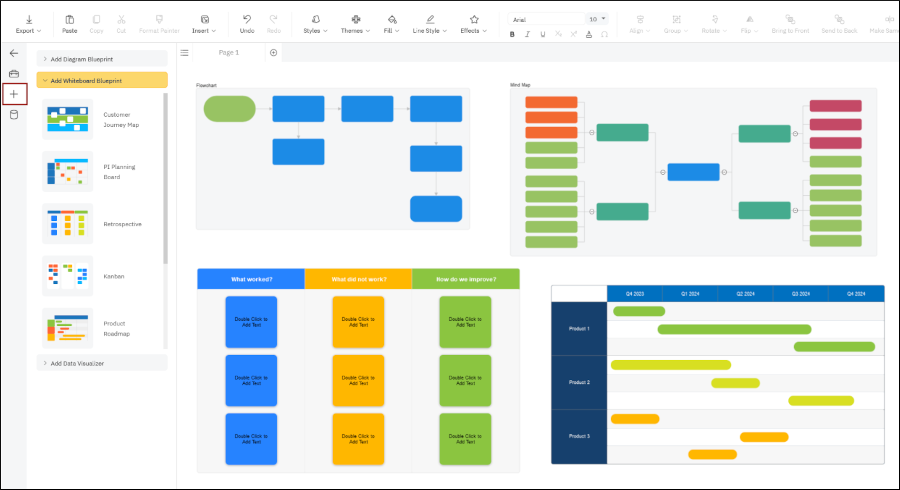
Misalignment is one of the biggest drains on productivity. Visual thinking tools create shared understanding by making ideas visible to everyone involved and make it much easier for teams to reach consensus.
When teams gather around a visual model, discussion becomes focused, assumptions surface quickly and misunderstandings are resolved in real time. People stop arguing interpretations and start improving the idea itself.
Why it matters: Shared visuals create shared reality. That’s the foundation of effective collaboration.
7. Visual thinking tools help you think more creatively and divergently
Visual layouts invite exploration. You can branch, rearrange, cluster and recombine ideas with ease. Moving an element to a new location in a mind map or diagram forces your brain to reconsider it in its new context. That can result in new connections and ideas.
Unlike text, which rewards completion, visuals reward experimentation. Nothing feels final, which makes it safer to explore bold or unconventional ideas.
Why it matters: Creativity thrives when thinking feels playful, flexible, and unconstrained.
8. Visual thinking tools streamline planning and execution
Visual thinking tools excel at showing both the big picture and the details. Roadmaps, workflows and visual plans help you see progress, dependencies, and next steps at a glance.
They’re not only useful for brainstorming and planning projects. They can also serve as living documents, helping you to manage project execution.
This reduces overwhelm while increasing follow-through. You always know where you are now and what comes next.
Why it matters: Clear plans reduce friction. Reduced friction leads to consistent execution.
9. Visual thinking tools support better storytelling and communication
Ideas are only as powerful as your ability to communicate them. Visuals anchor stories, guide attention and make complex messages easier to grasp.
Whether you’re presenting, teaching, selling or persuading, visual thinking tools help your audience follow your logic and retain your message.
Why it matters: Clear communication multiplies the impact of good ideas.
10. Visual thinking tools create reusable, evolving knowledge assets
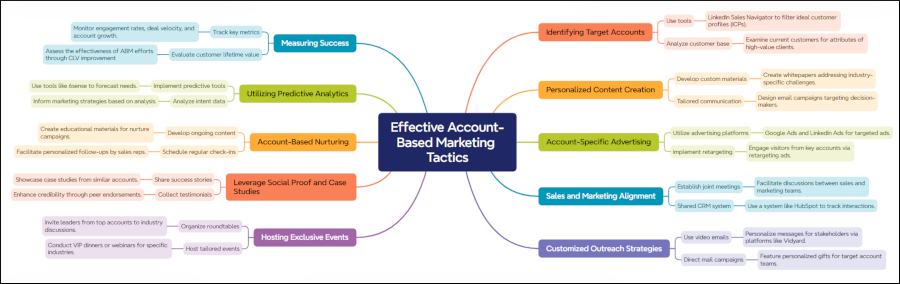
Unlike static notes, visual models can grow and adapt. You can refine them, extend them or reuse them in new contexts.
Over time, your collection of visual artifacts becomes an external thinking system, a personal knowledge base that reflects how you understand the world.
Why it matters: Thinking once and reusing ideas and frameworks can be a powerful productivity multiplier.
The bigger picture
Visual thinking tools don’t just help you work faster. They help you think better. They reduce friction between thought and action, between ideas and execution, between individuals and teams.
In a world that rewards clarity, creativity and impact, learning to see your thinking may be one of the most valuable skills you can develop.
Intrigued by what visual thinking tools make possible?
Leave a Reply