
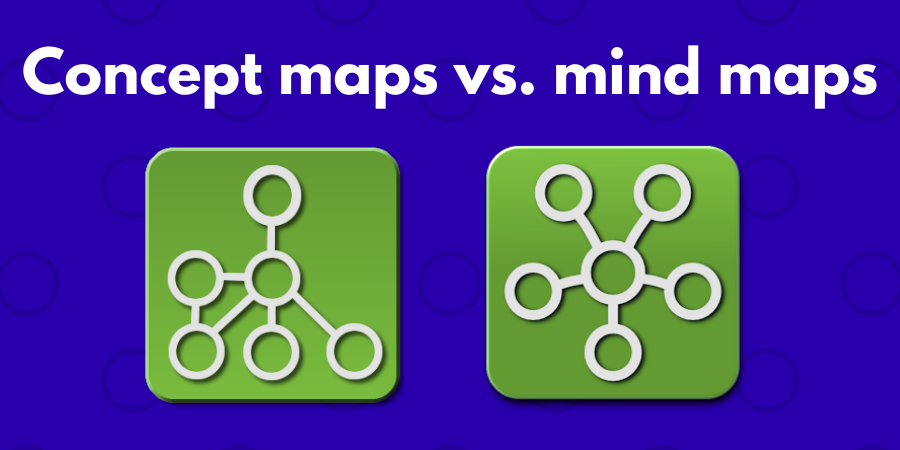
What’s the difference between concept mapping and mind mapping? These two types of visual mapping look very similar, which tends to cause a lot of confusion among people who are just learning about them. Here is a detailed comparison of these two popular types of diagramming and their uses in business:
Concept maps
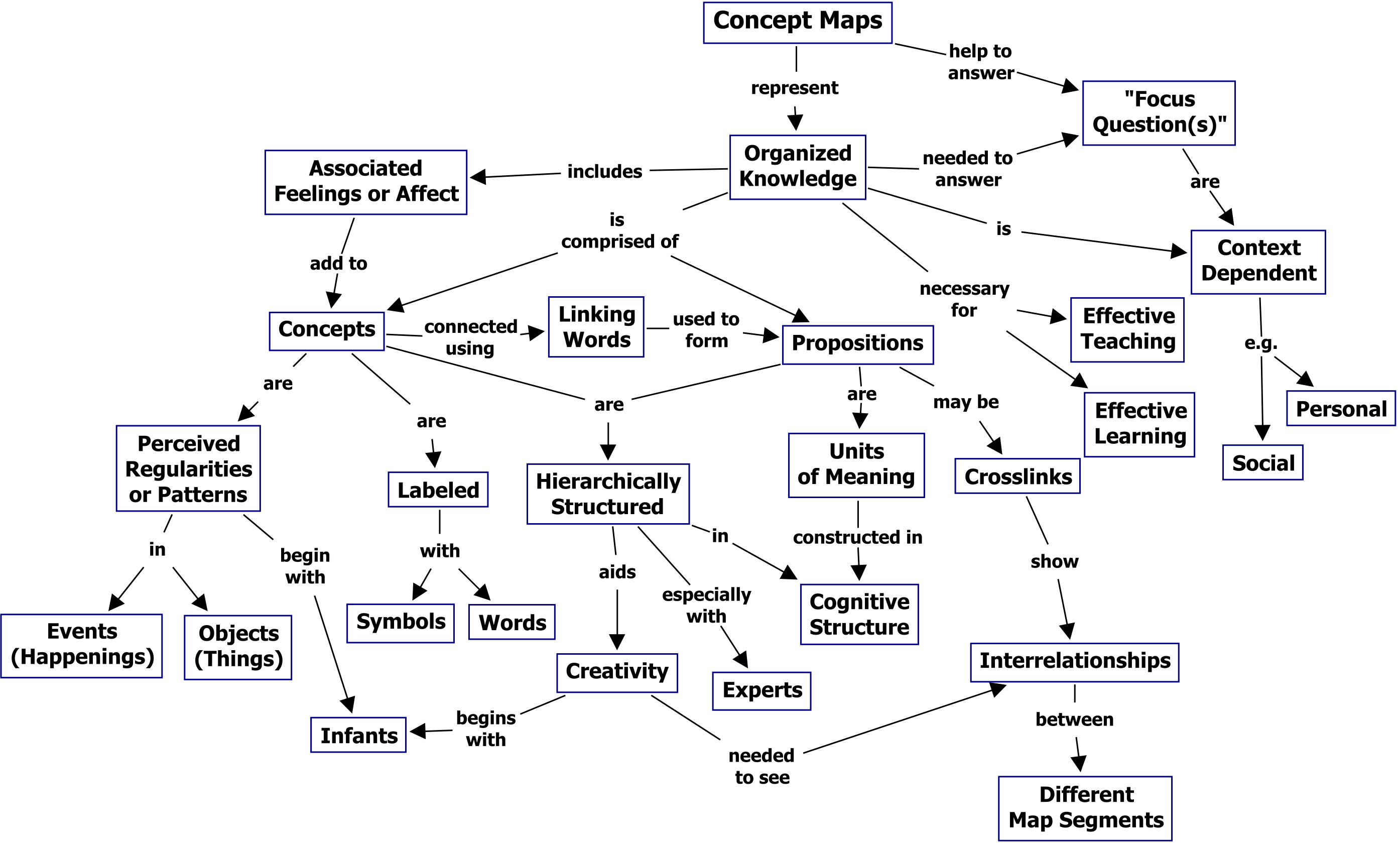
Definition: A concept map or conceptual diagram is a diagram that depicts suggested relationships between concepts. It is a graphical tool that instructional designers, engineers, technical writers, and others use to organize and structure knowledge.
Visual structure: A concept map typically represents ideas and information as boxes or circles, which it connects with labeled arrows in a downward-branching hierarchical structure. The relationship between concepts can be articulated in linking phrases such as causes, requires, or contributes to.
One thing that makes concept maps different than mind maps is that a topic can have multiple parents and children. That makes it ideal for modeling complex relationships between pieces of information.
The main application of concept mapping is knowledge representation.
Characteristics of concept maps:
- Are commonly used to organize and represent tacit knowledge.
- Usually contain general concepts at the top of the map, with more specific concepts arrayed hierarchically below.
- Connector lines usually contains keywords or phrases that summarize the relationship between the topics they connect. Such as topic a “causes” topic B.
- Topics may be cross-linked with each other to depict more complex relationships between topics. Topics in mind maps may only have one parent; in a concept map, a topic may have multiple connector lines, each one representing a different relationship.
NEW – Concept mapping resource list: Want to know more about concept maps and their use in business? I’ve created an information-packed resource list that includes:
- A selection of articles about business applications of concept mapping,
- A list of applications that enable you to produce concept maps,
- Examples of business-focused concept maps, and
- Books about concept mapping.
Download the Concept Mapping Resources Guide now
Mind maps
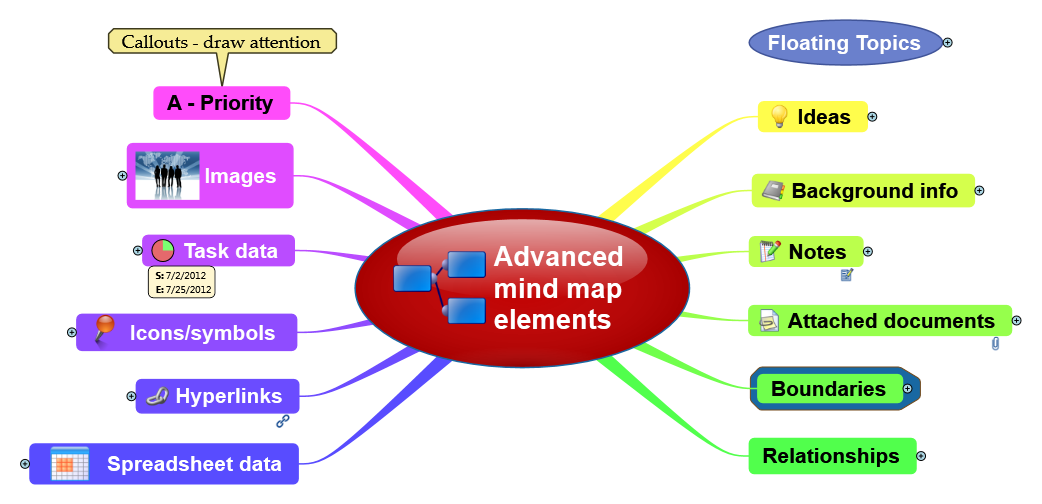
Definition: A mind map is a diagram used to visually organize information. A mind map is hierarchical and shows relationships among pieces of the whole. It is often created around a single concept, drawn as an image in the center of a blank page, to which associated representations of ideas such as images, words and parts of words are added. Major ideas are connected directly to the central concept, and other ideas branch out from those.
Visual structure: A central topic declares the subject of the mind map. First-level topics, sometimes known as “basic ordering ideas,” define the scope of the topic to be covered by the mind map. Sub-topivcs radiating from them are known as “child topics.” A mind map may contain as many layers of topics and subtopics needed to met the mind map’s purpose. Topics may be embellished with shape colors, fonts, size and ciolor. In addition, icons and images can be attached to mind maps.
Characteristics of mind maps:
- Tend to be more flexible and personal than concept maps.
- Are used to slice and dice the map’s central topic or concept in multiple ways.
- May contain images and color, to make them more visually stimulating
- Topics may only have a single parent


The is an unfair comparison. It "suggests" that somehow Mind maps are better [e.g. Mind maps are more flexible]. This is complete nonsense. Mind maps are the very worst study tool in contrast to Concept maps. Mind maps come from "popular psychology, otherwise laughed at by academics as voodoo nonsense". Concept maps become from 30 years of body of research: are very grounded in research, are DISTINGUISHED from "pop psychologist and voodoo" and yield OUTSTANDING results.
Although I will not give away my own research – I will say this: do a mind map, and then do not look at it for a few months , and you will notice it is very hard to understand. Or you can do a "idea map" with more information, but you will see it is ugly to read through it.
In contrast, do a good concept map and you can understand it 1 year later! Also you can see, and particularly another expert [e.g. teacher] can see whether AND to what EXTENT you have understood a subject-matter. The teacher can even grade you on your concept map alone [something not possible to do precisely using mind map because it is too generalised].
I have found "topics having only a single parent" the biggest limitation in mind maps. The idea of organising concepts radiantly around a single source is very useful for brainstorming and similarly focused activities. However, in other cases, when trying for example to analyse the key factors in a market and their interactions, concept maps are far more practical.
I use both, I find mind maps are fantastic when brain storming or trying to understand an idea which then gets translated into a document, presentation or training course as they are quick get all info on one page and you have to decide when to stop!!! Saying that a limitation is the single parent is a poor excuse as you can map and sub map or as I do use a map to scope a single piece of work
I use concept maps when I have a specific issue / task I want to work throughto identify potential solutions or way forward.
I can revisit either at any time and still understand what they are for and what they mean. I use the tool that works best for me based on what I am trying to do so both have their place and both are extreemly useful tools.
I use MindManager for mind mapping as well as Vue for concept mapping on my Mac. I would really prefer to have a single tool that does both. Does anyone know of such a product.
Thanks.
Richard
XMind does
Doesn't MindManager do both? I thought you can do concept maps in MindManager.
Interesting. Very similar in notation to entity relation diagrams from SSADM and interestingly, while not using exactly the same notation, class diagrams in UML as there are 1 to many relationships, verbs and entities. As a Mindmapper and systems modeller, this is a useful angle. I would draw these concept diagrams in Visio unless I use activity diagrams in Enterprise Architect (Sparx systems). Regards Mark http://wordenvie.com
The limitation of “a single parent” is a limitation by definition defined by wikit, which is by no means a standard. Mind map provides a convenient way to visualize vague ideas and thoughts in a form an interconnected map. It captures the most fluidic ideas, which creativity is embodied, otherwise likely disappear temporally. Mind maps are certainly not as well formed as concept maps, because illustration of relationship among well established concepts is not a purpose of mind maps.
Is it really necessary to distinguish a "concept map" from a "mind map" ? Maybe "yes" in the same way its useful to distinguish a mind map from a dump.
I agree with all the views presented here. In my book if its a map its a visual representation of info in a hierarchy that aids recall.
The beautiful concept map presented here is really a bunch of related mindmaps – and its useful.
Thanks for a great little discussion!
There is a method that has been created to unite the core benefits of both approaches: "iMapping" is based on hierarchical structure that also allows to map interrelations. Additionally, since it is based on nesting and zooming, iMaps can become very large with many thousands of items without sacrificing overview. iMapping unites the hierarchy of Mind Maps and the simplicity of pin boards with the network structure of concept maps. Update: The all new Version of the original iMapping Tool is infinitymaps.io
Here is a short youtube video to give an impression about it.
— Disclaimer: Yes I have stakes in iMapping. It was my PhD project to create it and it is my current business to run a startup around it. My above claims however have been repeatedly validated by customers and free users. A permanently free version of the iMapping Tool / Infinity Maps is available.)