Mind mapping white space: Does it work with software?
Apr 15th, 2010 | By Chuck Frey | Category: Discussion
“White space” ideas are those that fall in between existing products, services, or ideas. In a business setting, white space opportunities are those that may lie between two existing business units, divisions or departments. Because both groups are so busy trying to keep up with their existing tasks and responsibilities, they tend to give little time or thought to the unmet customer needs or untapped possibilities that reside between existing products, services and businesses.
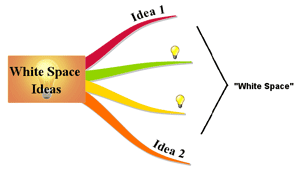
Mind mapping software is a perfect tool for exploring white space opportunities, because it leverages the brain’s powers of association. Tony and Barry Buzan point out in their highly-regarded The Mind Map Book that a great way to coax new ideas forth from your marvelous brain is to insert several blank branches in your hand-drawn map. Your brain, which can’t stand to see any pictures be incomplete, will usually comply and generate ideas to fill those blanks.
Why question to you is this: I know this technique works with hand-drawn mind maps, but have you tried it with mind mapping software? I look forward to your thoughts!
Popularity: 2% [?]


White space on a “Mind Map” or any other Information Map (as that is what I prefer to call them) is quite critical.
When you have too much information on a “map”, or any other document for that matter, it creates confusion and severely reduces clarity.
Products that compact the content of these documents will lose a vital part of the process of visual information management.
Clarity and focus is paramount when using visual information. Put too much into too little and confusion will reign.
Just my humble opinion.
I’ve used this technique in both types of mind maps and it I have to say it’s very effective as a way of generating new ideas and thoughts.
A great place to use this for software mind maps is in template mind maps. Using a template mind map with empty branches is a great way to get you started straight away on a new mind map.
Having experiment with many of the Mind Mapping tools available over the last few years I would certainly agree that software can be as effective as a hand drawn map in terms of stimulating ideas due to white space. The fantastic development in mapping software has allowed the technique to be fully utilised by those of us who are not fantastic as artists using pen and paper. I have found that the best products are those which allow you to both speed Mind Map and also manually allow you to layout branches like iMindMap.
I would suggest that the speed mapping of many applications retains the flow of ideas generation, allowing you to focus on the imagery and layout of maps after your thoughts have been defined.
I have found during my own study and teaching that the application of image and colour after the thought recording has taken place leads to a deeper thought process being undertaken as a second phase, whilst still retaining the association and recall benefits of using imagery and codes.
Having experiment with many of the Mind Mapping tools available over the last few years I would certainly agree that software can be as effective as a hand drawn map in terms of stimulating ideas due to white space. The fantastic development in mapping software has allowed the technique to be fully utilised by those of us who are not fantastic as artists using pen and paper. I have found that the best products are those which allow you to both speed Mind Map and also manually allow you to layout branches like iMindMap.
I would suggest that the speed mapping of many applications retains the flow of ideas generation, allowing you to focus on the imagery and layout of maps after your thoughts have been defined.
I have found during my own study and teaching that the application of image and colour after the thought recording has taken place leads to a deeper thought process being undertaken as a second phase, whilst still retaining the association and recall benefits of using imagery and codes.
I’ve used this technique in both types of mind maps and it I have to say it’s very effective as a way of generating new ideas and thoughts.
A great place to use this for software mind maps is in template mind maps. Using a template mind map with empty branches is a great way to get you started straight away on a new mind map.
I’ve used this technique in both types of mind maps and it I have to say it’s very effective as a way of generating new ideas and thoughts.
A great place to use this for software mind maps is in template mind maps. Using a template mind map with empty branches is a great way to get you started straight away on a new mind map.
Having experiment with many of the Mind Mapping tools available over the last few years I would certainly agree that software can be as effective as a hand drawn map in terms of stimulating ideas due to white space. The fantastic development in mapping software has allowed the technique to be fully utilised by those of us who are not fantastic as artists using pen and paper. I have found that the best products are those which allow you to both speed Mind Map and also manually allow you to layout branches like iMindMap.
I would suggest that the speed mapping of many applications retains the flow of ideas generation, allowing you to focus on the imagery and layout of maps after your thoughts have been defined.
I have found during my own study and teaching that the application of image and colour after the thought recording has taken place leads to a deeper thought process being undertaken as a second phase, whilst still retaining the association and recall benefits of using imagery and codes.
I use template mind maps with empty branches – it works !