
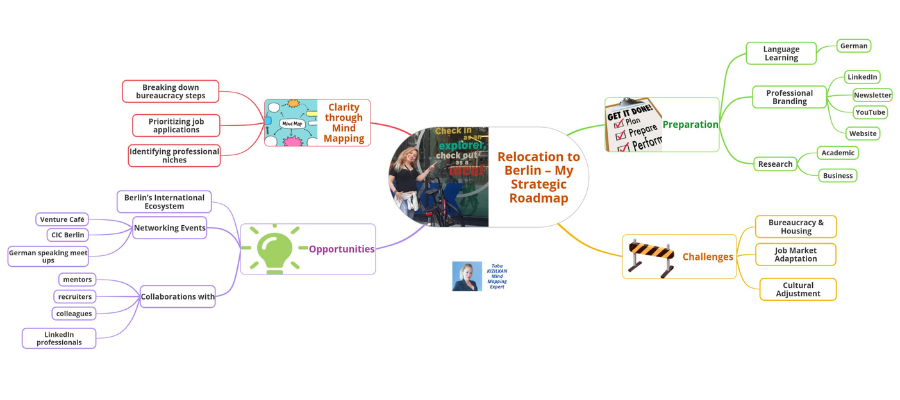
When mind mapping expert Tuba Kizilkan decided to change careers and move from her native Turkey to Berlin, the amount of details she needed to think about and plan for were overwhelming.
To cut these challenges down to size and empower this huge life pivot, she naturally turned to mind mapping. You can learn a lot from the way she approached it, regardless of your profession or where you are on your life’s journey. Prepare to be inspired by Tuba’s remarkable story.
Chuck Frey: Tell me about your professional background. What’s been the focus of your career so far?
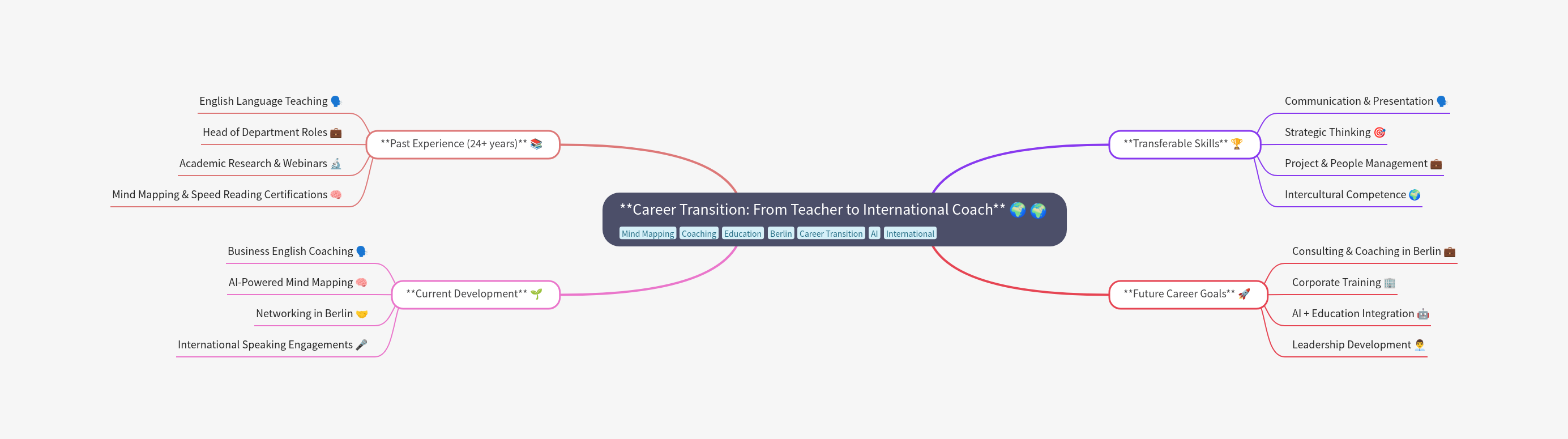
Tuba Kizilkan: I have been an English language teaching professional for more than 24 years. A major part of my career has been dedicated to teaching young learners and teenagers in schools, where I focused on curriculum design, language acquisition, and long-term academic development.
In parallel, I have also coached Business English to professionals from industries such as finance, engineering, architecture, and technology, helping them strengthen their communication, presentation, and leadership skills.
Beyond language teaching, I expanded my expertise into cognitive and learning strategies. I trained under a Tony Buzan-licensed instructor in Mind Mapping, as well as in Speed Reading and Memory Techniques. These certifications allowed me to integrate powerful tools into both education and professional training, equipping learners with strategies for clarity, creativity, and improved performance.
Frey: Tell me a bit about your history as a mind mapper.
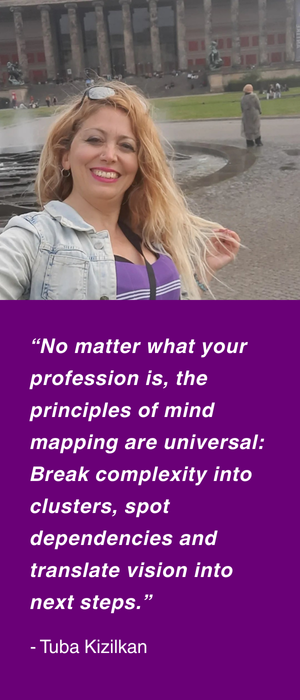 Kizilkan: Yes, that’s correct. Over the years, I have created more than 700 mind maps across diverse topics — including language learning, business strategy, professional development, well-being, education, technology, and AI.
Mind mapping has become not just a tool I use occasionally, but my default way of thinking, planning, and communicating. For me, it is a “thinking technology” — in other words, my system for structuring knowledge, connecting ideas across domains, and accelerating both personal and professional growth.
I have also been active in sharing this practice with the international mind mapping community. I have presented three times on Biggerplate, the world’s leading platform for mind mapping, and have been invited to speak in webinars about how maps support professionals and educators in transforming complexity into clarity.
Frey: You’ve said that mind maps have rewired the way you think. Can you explain what you mean?
Kizilkan: Creating more than 700 maps has fundamentally reshaped the way I approach thinking and decision-making. I’ve become much better at prioritizing, quickly identifying what is essential, and setting aside what can wait.
I now naturally see both the bigger picture and the underlying structure of any situation. In daily life, I apply the same principle as when I build a map: detecting the key points that truly matter, instead of being distracted by irrelevant details.
This has given me a clearer, faster, and more focused way of thinking — turning every decision into an exercise in clarity and alignment.
Frey: What made you decide to move to Berlin and start a new career?
Kizilkan: My decision to move to Berlin was driven by both purpose and strategy. After more than 24 years of teaching, research, and coaching, I realized that I wanted an environment where my skills could create broader impact.
Berlin offers exactly that. It is a city that thrives on innovation, diversity, and international collaboration. It brings together leaders in technology, business, education, and the creative industries — all areas where my expertise in Business English, communication strategy, and mind mapping can directly contribute.
At the same time, Berlin is a hub where new ways of thinking are not only welcomed but necessary. My background in combining language, visual thinking, and neuroscience-based learning strategies aligns well with the city’s forward-looking ecosystem.
Frey: How would you describe your ideal outcome for this move?
Kizilkan: To establish myself in Berlin as the go-to advisor at the intersection of Business English, strategic communication, and AI-powered mind mapping.
Concretely, my goal is to build a bilingual (EN/DE) boutique practice with three flagship offerings:
- Clarity Sprints (90–180 min): workshops that turn complex issues into visual roadmaps, decision trees, and 30-day action plans.
- Executive Communication Lab: coaching for international managers — board-ready messaging, presentation strategy, and stakeholder alignment.
- Neuro-Inclusive Collaboration Program: workflows and meeting designs that reduce cognitive load and enable diverse teams to perform at their best.
Within 6–12 months, I aim to deliver measurable outcomes, publish case studies, and partner with local hubs like Venture Café, accelerators, and universities.
Frey: If I recall correctly, you made short trips to Berlin before deciding to relocate. What did you learn?
Kizilkan: Yes, that’s true. Before making the full decision, I approached Berlin the same way I approach complex challenges — through small, strategic experiments. I made several short trips, each with a specific focus:
- Networking — attending events such as Venture Café and CIC Berlin gatherings.
- Cultural immersion — testing daily life and rhythm of the city.
- Market validation — speaking with recruiters and managers about where my skills fit.
- Personal adaptability — testing how quickly I could navigate the city and handle practical aspects like housing and bureaucracy.
- What I learned was invaluable. Berlin is not only a city I feel at home in, but also a place where my skills are needed.
Each visit confirmed that the combination of international communication expertise and visual strategic tools could bring real value here.
Frey: Did you create a mind map to support your decision?
Kizilkan: Absolutely. I created a dedicated “Berlin Relocation” mind map, which served as both decision-support and action plan.
- At the center was the question: “Is Berlin the right next step for my life and career?”
- Main branches: Career Opportunities, Networking & Community, Language & Integration, Logistics, and Personal Growth.
Mapping it out made dependencies visible — for example, realizing that housing had to come first before registration and health insurance could proceed. That clarity turned what felt overwhelming into a structured plan.
Frey: The thought of moving must have been overwhelming. How did mapping help you handle it?
Kizilkan: It really reduced the anxiety. Instead of seeing relocation as one giant, intimidating challenge, I broke it down into structured clusters: housing & bureaucracy, career & networking, language learning, and personal well-being.
Every time I completed a sub-branch, the map reminded me I was moving forward. That gave me confidence and momentum.
Frey: Why do Berlin companies in particular need this?
Kizilkan: Berlin is full of international teams. Germans often think in systems; internationals often think in stories. That mix is powerful, but it can also create misalignment.
Mind mapping bridges the two. It gives everyone a shared visual language — one page that shows purpose, priorities, risks, and next steps. For Berlin startups that move fast but often document poorly, this makes a huge difference. It’s not about more paperwork; it’s about a clearer picture that everyone can act on immediately.
Frey: How are your lessons transferable to others?
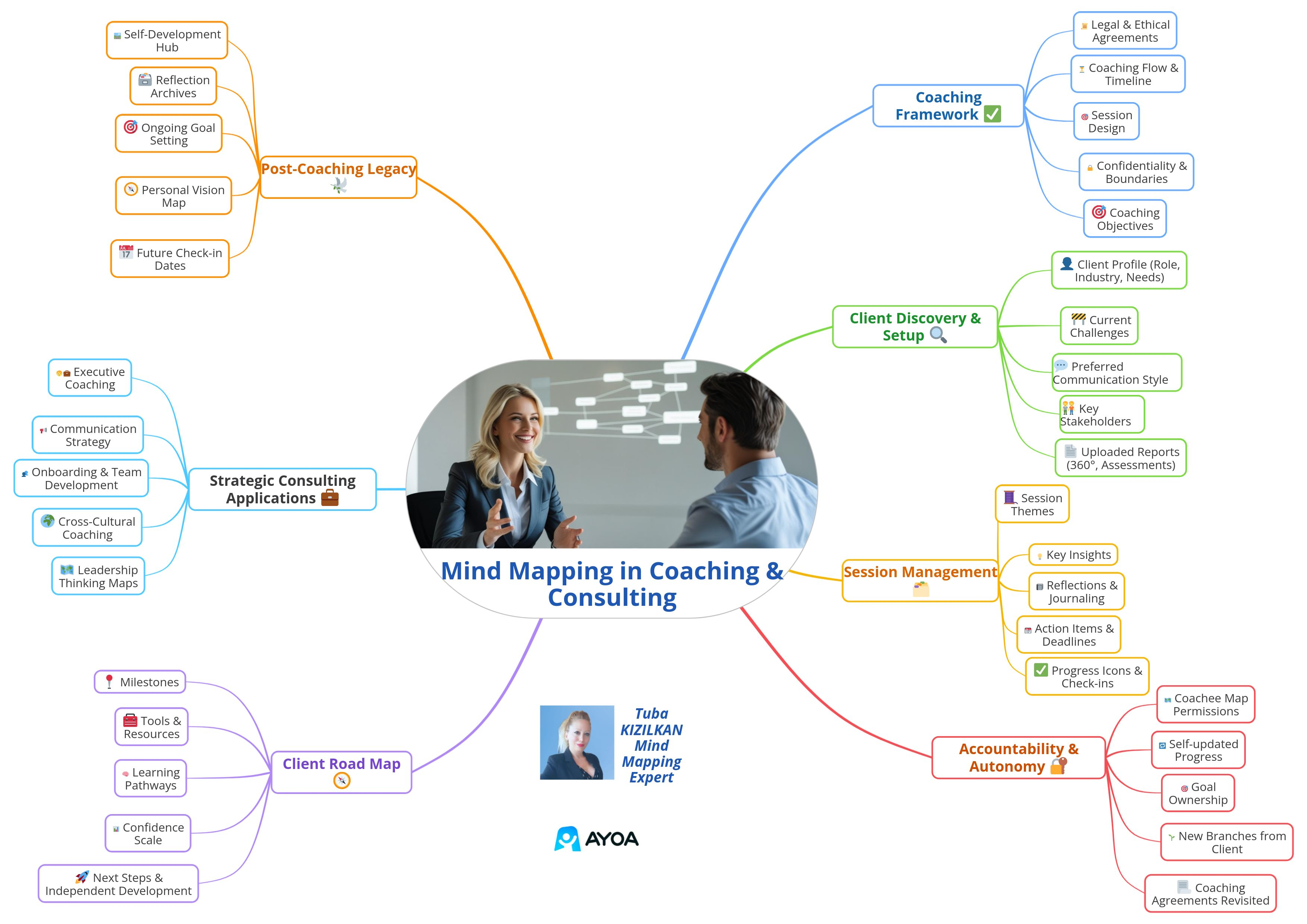
Kizilkan: The principles are universal. Whether it’s a manager launching a project, a consultant guiding change, or a student balancing priorities, the same steps apply: break complexity into clusters, spot dependencies, and translate vision into next steps.
Mind mapping is not bound by profession — it’s bound by the human need for clarity.
Frey: Any final thoughts you’d like to share?
Kizilkan: My relocation to Berlin is about more than geography. It is about building clarity where it is most needed. From classrooms to boardrooms, from Izmir to Berlin, I’ve seen how a single map can transform not just a workflow but a mindset.
This is what I want to bring to Berlin: clarity as a real, practical advantage for people and teams navigating complexity.
Frey: Where can Visual Velocity readers follow your work online?
Kizilkan: The best place, where I’ve been documenting my journey and sharing what I’ve learned about mind mapping, is on LinkedIn. You can follow me or connect with me here.
Leave a Reply