
Your brain’s default thinking mode is quietly killing your best ideas
In an era when AI can generate mountains of mediocre ideas on demand, your ability to think divergently, to escape your brain’s default patterns and generate genuinely original, high-value ideas, has never been more important.
That’s not a theory. It’s a conclusion backed by two decades of studying creativity and confirmed by a growing body of research. And yet, for most executives, entrepreneurs, and creators, divergent thinking remains a largely untapped superpower.
Let me explain why that needs to change — and what to do about it.
Your brain is working against you
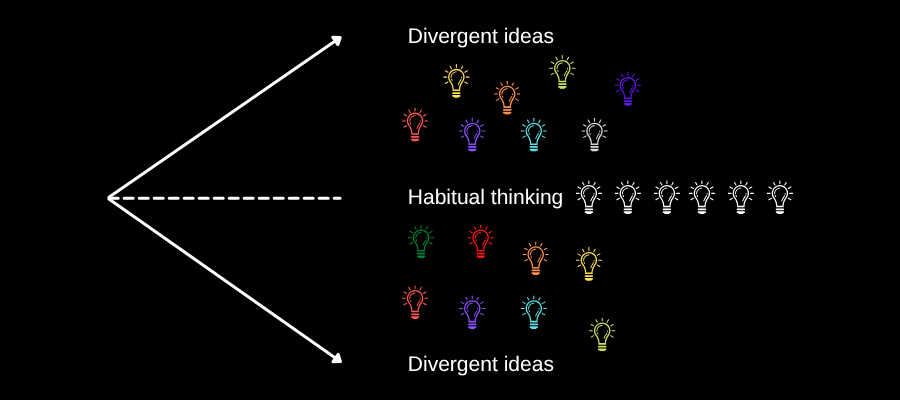
Here’s something I’ve observed after 20 years of studying and writing about creativity: our brains are profoundly habitual. Left to their own devices, they follow well-rutted paths of thinking — comfortable, predictable neural grooves worn deep by repetition and routine. The ideas your default mindset produces tend to be predictable and, frankly, of low value. They are the cognitive equivalent of reheated leftovers.
Higher-value ideas — the kind that unlock new business models, solve problems that have stumped your competitors, and accelerate your career — come from a fundamentally different mode of thinking.
That mode is divergent thinking.
Coined by psychologist J.P. Guilford in 1967, divergent thinking is the cognitive process of generating multiple, varied, and original solutions in response to an open-ended problem. As neuroscientist Dr. Andrew Huberman describes it, divergent thinking “involves taking one simple stimulus and trying to radiate out from that as many different situations, properties, characteristics, and events as possible.” Think of it as the opposite of the convergent thinking you do most of the day — solving problems by zeroing in on a single, logical answer. Divergent thinking is wide, expansive, exploratory. Convergent thinking is narrow, evaluative, decisive. You need both, but most of us are wildly out of balance.
Prompts and unique stimuli help shift your brain out of its default mode. So do creative problem-solving techniques, which often force you to think in different directions or view your challenges from perspectives you’d never naturally adopt. More on those in a moment.
Why should you care. Even if you don’t think you’re creative
“I’m not a creative person.” I hear this constantly. It’s almost always wrong.
Divergent thinking isn’t an innate gift reserved for artists and inventors. It’s a trainable cognitive skill — and its business case is hard to argue with. McKinsey research found that companies that facilitated divergent thinkers grew 2.3 times faster than those that didn’t. Sixty percent of CEOs cite creativity as the most critical factor for navigating complexity.
Creativity expert Mark Runco puts the stakes plainly: a flexible, divergent thinker “will have alternatives and choices when solving problems, and therefore solutions are likely and frustration and distress are unlikely. Inflexible individuals, on the other hand, follow routines, make assumptions, and have difficulty when problems lead to fixedness.”
In other words: divergent thinking isn’t a nice-to-have creative flourish. It’s a competitive survival skill.
Why AI makes your creativity more valuable, not less
Here’s where it gets both interesting and urgent.
A landmark 2024 University of Arkansas study published in Scientific Reports found that GPT-4 outperformed most humans on standardized divergent thinking tests, generating more original and elaborate ideas than 151 human participants. Headlines ran with it: AI is more creative than you.
But dig deeper, and a very different picture emerges. Researchers from the University of Essex found that while AI excels at what they call “mid-level novelty” — clever combinations of familiar patterns — it rarely approaches the genuinely breakthrough ideas that only the best human thinkers produce. In their 2025 study, only 0.28% of AI’s ideas reached the top tier of human creativity benchmarks, and humans were 35 times more likely to produce a truly standout, original idea. AI circles the familiar. It doesn’t leap beyond it.
Even more alarming: a 2026 study published in PNAS Nexus found that while AI chatbots can match humans on individual creative tasks, they produce strikingly similar responses to one another. Widespread reliance on AI for idea generation risks what researchers call a “homogenization effect” — a narrowing of the idea space across entire organizations, industries, and societies. Job applications, marketing campaigns, and strategic plans are already starting to sound alike because they’re being scaffolded by the same AI systems making the same probabilistic word choices.
Most alarming of all: this narrowing effect persists even after people stop using AI tools. Their creative capacity appears to atrophy, like a muscle that’s been immobilized.
My take? AI absolutely should not be used as a substitute for human thinking. When you outsource your ideation to an AI model, you don’t just produce predictable output. You gradually train yourself to think less creatively over time.
That said, as an amplifier for human thinking, AI can be genuinely valuable. Here are three approaches I find particularly effective:
Use AI as a combination engine. Brainstorm your own list of ideas first, then ask AI to identify opportunities to combine them, improve them, or make unexpected connections between them. You bring the raw material; AI helps you recombine it in ways you might not have considered.
Use AI to challenge your blind spots. After you’ve thought through a challenge, share your thinking with an AI tool and ask it directly: “What am I missing here? What other perspectives should I consider to unlock new insights?” This is AI at its best — not generating ideas for you, but revealing the gaps in your current thinking.
Use AI as a cross-industry researcher. One of the richest sources of breakthrough ideas is discovering how other industries or professions have solved analogous problems. Ask AI to research how similar challenges have been addressed in completely different domains. You may be able to adapt part or all of their solutions to your own context.
The key principle: you think first, AI amplifies second. Reverse that order, and you’ve surrendered your most valuable cognitive asset.
Divergent and convergent thinking: The creative tandem
Divergent thinking doesn’t operate in isolation. The complete creative process moves through two distinct phases that creativity experts have long recognized:
Divergence is the first stage — generating a wide, diverse variety of ideas, free from judgment and premature evaluation. You’re pushing beyond your well-rutted paths of thinking to consider new possibilities. Mind mapping software is perfectly suited to this phase: it lets you branch out in as many directions as your thinking takes you, with almost complete freedom, capturing ideas, questions, knowledge gaps, and connections all in one visual space.
Convergence follows: narrowing the field, evaluating your ideas against criteria, identifying the most promising ones, and turning them into action. In mind mapping software, this is supported by the ability to move topics around, rearrange them to test new relationships, add priority icons, and build implementation notes onto the ideas that earn further development.
All divergence and no convergence produces a beautiful cloud of unrealized potential. All convergence and no divergence produces the same safe, incremental thinking that got you to where you are now, but nowhere new. The most effective creative process alternates between them: expand, then evaluate; explore, then decide.
Popular techniques for divergent thinking
If you’re ready to start developing this skill, here are some of the most proven approaches:
Brainstorming: The classic. Set a timer, define a specific problem, and write down every idea that comes to mind — suspending judgment entirely. Volume is the goal in the divergent phase. Evaluation comes later.
Mind mapping: Start with a central challenge or concept and branch outward, following your associations wherever they lead. Mind mapping is especially powerful because it mirrors the radial, associative way your brain actually works — unlike the linear format of a word processor, which constrains your thinking to a single track.
SCAMPER: One of the most structured and versatile divergent thinking techniques. The acronym stands for Substitute, Combine, Adapt, Modify, Put to another use, Eliminate, and Reverse. Applied to any existing idea, product, or challenge, SCAMPER systematically dismantles your assumptions and generates new possibilities from what’s already in front of you.
Analogical thinking: Deliberately look for how seemingly unrelated domains have solved similar problems. A logistics challenge might find its solution in how a hospital manages patient flow. A product design problem might find its answer in how a forest manages resources. Cross-domain analogies are one of the richest sources of original thinking available to any thinker in any field.
Brainwriting: Like brainstorming, but done silently and in writing. Each participant generates ideas independently, then builds on others’ ideas as papers rotate. This prevents louder voices from dominating the session and typically produces a more diverse idea pool.
How visual thinking tools supercharge the process
After 20 years of working with visual thinking tools, I find them invaluable at every stage of divergent thinking — not just as a recording medium, but as an active thinking partner.
Here’s why they’re so powerful:
They externalize your thinking. Getting your ideas out of your head and onto a visual canvas frees your brain to continue generating. Once captured in a mind map, those ideas also serve as catalysts for new associations, because mind mapping supports the way your brain loves to work: by association. Think of it as thinking about your thinking.
They break the linearity trap. Word processors force your thinking into a single track. Visual tools — mind maps, whiteboards, concept diagrams — let you spread ideas across a canvas in any direction. This spatial freedom directly enables divergent thinking by removing the structural constraint that your next idea must follow logically from your last one.
They reveal patterns that linear tools hide. One of the most powerful capabilities of mind mapping software is the ability to classify ideas with colors, shapes, and icons — and then move them around to test new relationships. When you drag a topic from one branch of your map to another (a technique called refactoring), you change its context. Its new neighbors often suggest connections that were completely invisible before.
They support both phases of creativity. In the divergence phase, a mind map is an infinite, flexible canvas — you can branch out in as many directions as your thinking takes you, capturing ideas, questions, knowledge gaps, and stakeholder considerations all in one place. In the convergence phase, the same tool lets you evaluate, prioritize, rearrange, and build action plans from the ideas you’ve generated.
They make team divergence richer. In group settings, collaborative visual tools allow multiple people to contribute to a shared canvas simultaneously, wherever they are. This democratizes divergent thinking — removing the dynamic where the loudest voice dominates ideation — and produces a far more diverse pool of ideas than a traditional meeting ever could.
How to make divergent thinking a daily habit
The good news: small, consistent practices compound over time into a genuinely more flexible mind:
Challenge your automatic thoughts. At least once a day, catch a reflexive assumption and force yourself to generate three to five alternative interpretations or approaches. This small practice rewires your brain toward flexibility over time.
Read promiscuously. Expose yourself to the widest possible range of ideas and domains, including fiction, nonfiction, poetry, science journals — e. Every unfamiliar concept is a new dot your brain can connect to something you already know.
Build incubation into your schedule. Your brain solves problems subconsciously during breaks. Walks, showers, and sleep allow unconscious processing to surface insights that focused effort can’t reach. Don’t just schedule deep work. Schedule the recovery that makes deep work possible.
Ask “What am I missing?” Make this a regular practice after you’ve thought through any significant challenge. Then genuinely attempt to answer it — or bring in outside perspectives, human or AI, to help.
The bottom line
Here is what 20 years of studying creativity has made clear to me: the leaders, entrepreneurs, and creators who will thrive in the years ahead won’t necessarily be the smartest or the most experienced. They will be the ones who refuse to let their thinking calcify into habit, the ones who have developed the discipline to push beyond their well-rutted paths and explore territory that their competitors haven’t thought to visit.
Divergent thinking is that discipline. And in an age when AI is rapidly producing competent, middling, homogeneous thinking at scale, genuinely original human thought is becoming the scarcest and most valuable commodity in business.
Visual thinking tools are your best ally in developing and sustaining this skill: externalizing your ideas, revealing unexpected patterns, and creating the spatial freedom your brain needs to generate the truly unexpected.
Leave a Reply