
Picture a marketing director with four agency proposals spread across her desk for next spring’s product launch. Three of them pitch the same big idea: an exclusive “insider” community for loyal customers. Two of those three even open with nearly the same tagline.
None of the agencies copied each other. They didn’t need to. Each one fed a similar brief into the same kind of AI tool, got back the most likely answer and polished it into a slick deck.
The fourth agency brought something she hadn’t seen before. They won the account.
The other three will never learn why they lost. Their debrief will say the client “went in a different direction.” That’s what makes me-too ideas so costly: nobody tells you your work sounded like everyone else’s. You just stop getting the call.
The hidden price of me-too ideas
Your version of that story depends on what you do for a living:
The deal that stalls. Your pitch hits every expected note. So did the last three your prospect heard, so they choose the cheapest option, or nothing at all.
The promotion that goes to someone else. You deliver on time, every time. But when leadership looks for people who bring fresh thinking, your name doesn’t come up.
The client who hires another consultant. Your recommendations are sound. They’re also what the client’s own team got when they asked the same AI tool last week.
The campaign nobody remembers. Your copy is clean and professional. It also sounds like every other company in your space, so your audience scrolls right past it.
The strategy with no edge. Your plan follows industry best practices to the letter. So does every competitor’s plan, which is exactly why it can’t give you an advantage.
There’s a slower cost, too. An MIT Media Lab study found that people who wrote essays with ChatGPT over four months consistently underperformed at neural, linguistic and behavioral levels compared with people who wrote on their own. Your thinking works like a muscle. Hand it off often enough and it starts to weaken.
Why AI keeps serving up the same ideas
This isn’t a glitch. Large language models work by predicting the most likely response. As strategy thinker Roger Martin points out, that means you get the most frequent answer, not the most outstanding one. Wharton researchers found that brainstorms assisted by ChatGPT produce less diverse ideas. In one experiment, nine people independently gave their invention the same name.
Here’s the problem many people never consider when they rely on the “easy button” of AI-generated ideas: if it can hand you an idea on the first try, it can hand the same idea to your competitors, your colleagues and your clients. A me-too idea isn’t necessarily a bad one. It’s just one that anyone can get without you.
So giving up AI isn’t the answer. Using it differently is: in a way that makes your thinking sharper and more distinctive, not more average.

A better way to think with AI
I’ve been writing about creative thinking and creative problem solving for more than two decades, and lately one question has fascinated me: what roles can AI play to amplify our creativity instead of replacing it?
I had my own opinions, but I wanted to hear from the world’s brightest minds. So I asked Claude, Anthropic’s AI assistant, to research how leading thinkers recommend using AI to amplify, enhance and extend human creativity. Then I pushed it further, adding futurists, innovators, creators and authors I admire. I vetted the findings against my own experience and found the advice it uncovered to be accurate, timely and well-documented. A few of the techniques surprised me, like having AI write a journal entry from your future self, six months after a big decision.
The result is 35 strategies drawn from the work of two dozen experts and research studies, organized into the seven stages of a creative problem-solving process. Running through all of them is one principle, which I call the core loop:
You think first. AI widens and challenges your thinking. You make the call.
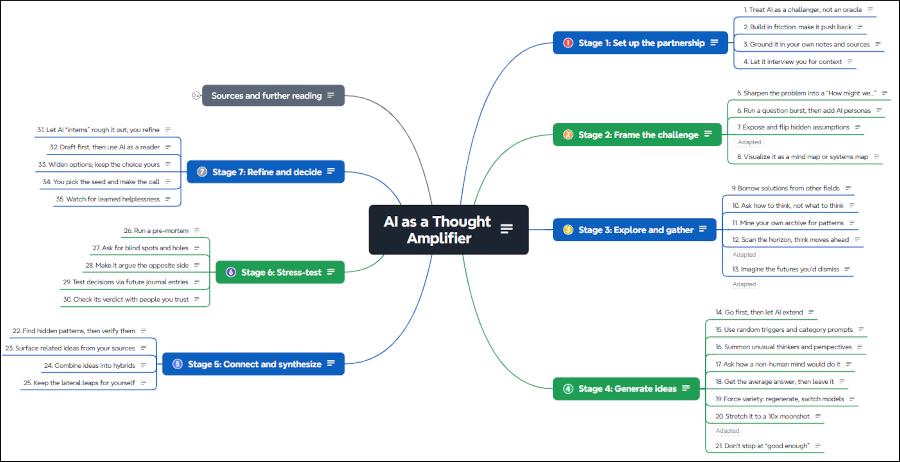
Here are three you can use today to break out of the me-too trap:
Go first, then let AI extend. Write down your own ideas before you look at a single AI suggestion. As Wharton’s Ethan Mollick warns, once you’ve seen AI’s ideas, it becomes much harder to think outside them. Then ask AI to combine your ideas into hybrids and push your boldest ones further.
Get the average answer, then leave it. Ask AI what most experts would recommend for your challenge. Then ask for five alternatives that deliberately break from that consensus. Once you’ve named the obvious answer, it’s much easier to avoid.
Ask for blind spots and holes. Organizational psychologist Adam Grant points out that AI can do something the people around you are often reluctant to do: question and challenge you. Try asking, “What’s a hole in this strategy?”
Get the complete field guide to amplifying your thinking with AI
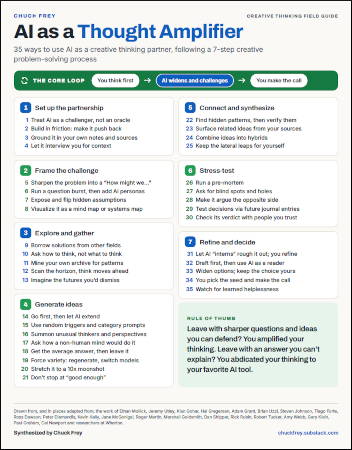 Those three will get you started. The other 32 are where the real difference shows up: how to frame a problem so you’re solving the right one, how to borrow ideas from fields your competitors never look at, how to combine ordinary inputs into something original and how to stress-test an idea before a client or your boss does.
I’ve packaged all 35 into AI as a Thought Amplifier, a 37-page visual field guide that walks you through the creative process one stage at a time. Inside you’ll find:
- A big-picture map of all seven stages, with every branch linked to its section
- 7 stage maps with “before you move on” checklists
- 35 strategy cards with the why, when and what to watch for
- A library of 35 ready-to-use prompts
- A printable one-page quick reference
- The complete, editable Xmind mind map, with notes and sources on every topic
The next time you walk into a pitch, a performance review or a strategy session, you won’t be bringing the same mediocre ideas as everyone else in the room.

Not ready to dive in yet? Download the free one-page summary of all 35 strategies and keep it beside your screen.
Think first. Then amplify.
Your competitors have access to the same AI tools you do. That won’t change. What will set you apart is how well you think with them.
Which of these strategies do you already use? Which one will you try first? Let me know in the comments. And if you’d like more on visual thinking, creativity and AI, subscribe to my Substack.
Leave a Reply