
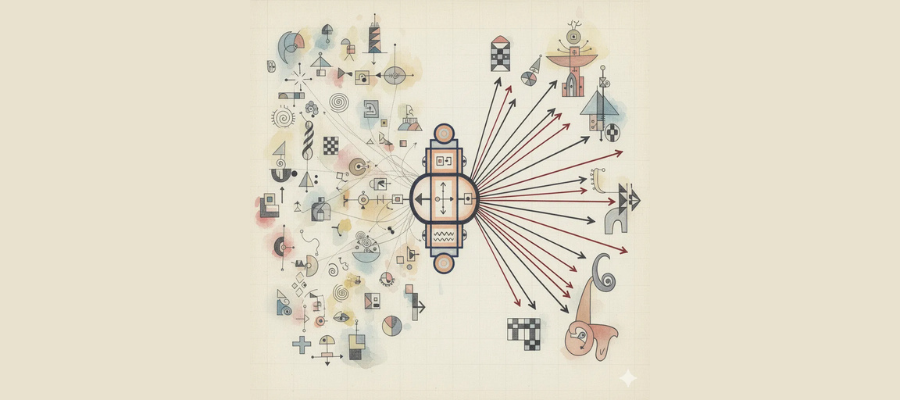
Have you ever had a powerful idea, rich, textured and exciting, only to watch it shrink into something flat and flimsy the moment you tried to explain it? We all have.
What you’ve experienced is called the communication bottleneck – the process of trying to transform a rich. multi-faceted set of thoughts into a linear series of spoken or written words.
If you want your ideas to stand out and capture attention, you need to examine how communication typically takes place. You also need to learn how to sidestep its limitations, according to the author of the Extended Mind Substack page.
What is the bottleneck – and why is it the enemy of effective communication?
The author compares the communication process to an hourglass.
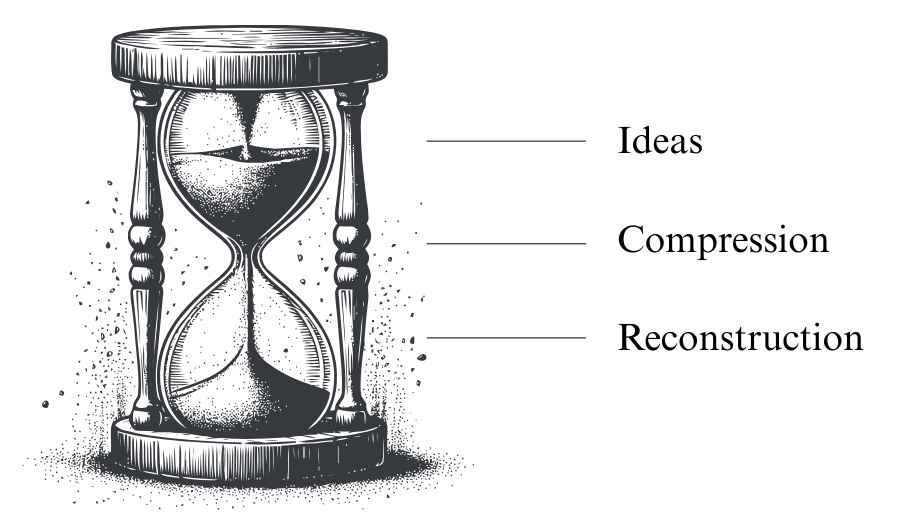
At the top are your thoughts – rich, multi-faceted, with many threads intermingling with each other in a river of ideas.
The narrow part of the hourglass represents the stage where we’re going to share our big idea with others. He calls this the bottleneck. Whether you’re trying to explain your idea verbally to a colleague, writing it out long-form or building a slide deck to present it, our tools often force us to reduce our rich thoughts into a linear, serial (one word at a time) format.
Done well, it becomes a useful tool for teaching, leading and persuading others.
What does this compression look like? Imagine a forest. When I look at a forest, my eyes take in millions of pixels: the sheen of sunlight on leaves, the serrated edges of pine needles, the motion of a breeze. But in my mind, it becomes just a forest. That compression is useful, until it’s time to share the idea with someone else.
The bottom of the hourglass is where the recipients of your communication reconstruct and hopefully understand it. As the author points out, effective communicators do this by compressing their ideas into patterns that their audiences will instantly recognize. The author explains:
“If the bottleneck is so severe, how does communication ever succeed? It succeeds because humans can learn to skillfully operate this internal control panel. Great communicators—artists, scientists, leaders, and poets—are not just speakers; they are masters of the bottleneck’s controls. They don’t just passively push information through; they actively manage the process of compression and reconstruction. Through their choice of words and structure, they don’t just send a message; they send a set of instructions for how to rebuild it.”
The author cites metaphor, narrative and naming as strategies that can help unlock meaning and context from spoken or written expressions of ideas.
The bottleneck is a really big problem
But many people don’t know how to use words in such advanced ways. As a result, much meaning is lost in this translation process. The problem becomes even worse when you consider how our society has conditioned us to consume information and ideas. In a world of sound bites, complex ideas don’t stand a chance.
For years, I’ve written about the challenges of linear thinking – presenting ideas in sequential words and concepts. But until I read this article, I didn’t fully appreciate how much this bottleneck can affect our ability to communicate our ideas effectively to others. It’s actually a really big problem, especially if you’re a writer, trainer, salesperson or anyone else who makes their living sharing their ideas and strategies with others.
But what if there’s a better (visual) solution?
What if you summarize your idea as a visual – a mind map, diagram or illustration? Or what if you provide your audience with a linear text summary but supplement it with a visual?
I believe this approach can help you preserve more of the richness and nuances of your idea while also making it easier for your audience to decompress and understand it. In comparison to the serial format of the written or spoken word, a well-designed image or diagram communicates in a gestalt fashion – all at once – and enables the person viewing it to not only understand the ideas it contains but also how they’re related.
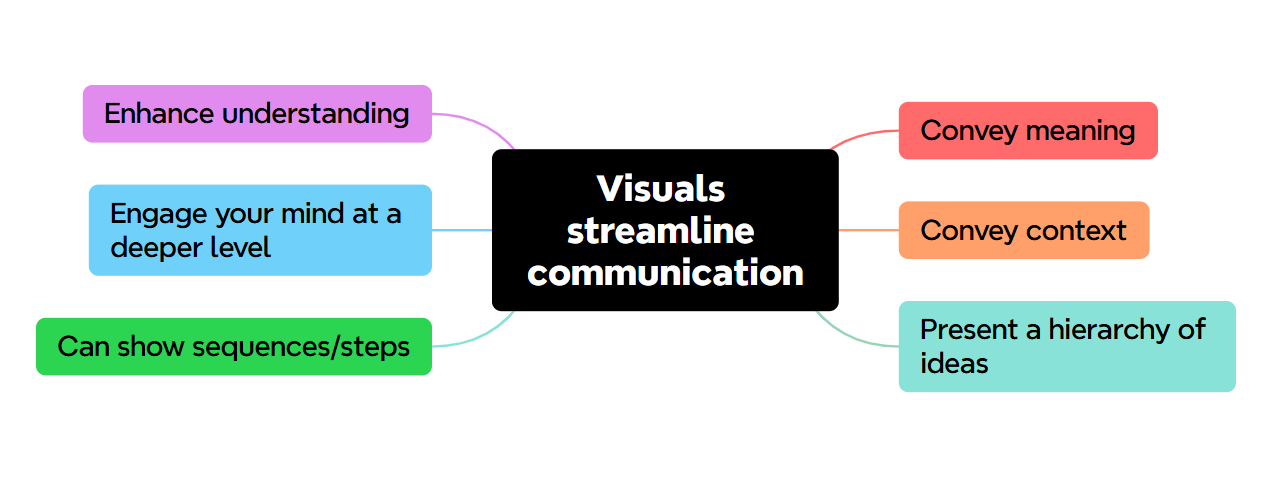
A well-designed visual can instantly make your ideas more compelling, memorable and persuasive.
The popular saying is absolutely true: A picture really IS worth a thousand words.
Leave a Reply