

Here’s a question worth sitting with for a moment: When was the last time you truly stopped to question what you think you know?
Not just accepted a headline, skimmed a briefing, or deferred to a colleague’s opinion — but genuinely examined the evidence, probed your assumptions, and worked your way to a reasoned conclusion through your own thinking process?
If you’re like most people, it probably hasn’t been recently enough. And in today’s world — where information arrives at fire-hose velocity, misinformation spreads faster than truth, and AI can generate plausible-sounding answers to just about anything — that gap in your thinking could be costing you more than you realize.
Critical thinking has always mattered. But right now, it matters more than at any other point in history. And as I’ve discovered in my years of exploring visual thinking tools, mind mapping is one of the most powerful frameworks available for developing and strengthening this essential skill.
Let’s dig into why — and, more importantly, how you can put it to work.
What is critical thinking, exactly?
Critical thinking is one of those terms that gets tossed around endlessly in corporate training programs and academic syllabi without anyone really defining it clearly.
Here’s the definition I keep coming back to, from the Foundation for Critical Thinking: critical thinking is the intellectually disciplined process of actively and skillfully conceptualizing, applying, analyzing, synthesizing, and evaluating information gathered from observation, experience, reflection, reasoning, or communication. It guides belief and action.
In plain English: it’s the habit of not taking things at face value. It’s the practice of asking “Is this actually true?” before you accept something, act on it, or pass it along.
Innovation expert Carla Johnson, who has spent two decades studying how people solve complex problems and create breakthrough solutions, frames it beautifully: critical thinking isn’t just an analytical skill — it’s the bridge between creativity and innovation. It’s what transforms OK ideas into extraordinary ones.
“Critical thinking isn’t just an analytical skill; it’s the bridge between creativity and innovation. It’s what transforms OK ideas into extraordinary ones.”
— Carla Johnson, Innovation Architect & Author of RE:Think Innovation
Think about that. Critical thinking isn’t the enemy of creative thinking — it’s what gives your creative thinking its teeth.
Scenarios where critical thinking Is… well, critical
You might be thinking: “I use critical thinking every day.” And you might be right. But let’s get specific, because the stakes become clearer when we put critical thinking in context.
Consider these everyday professional scenarios:
- A vendor presents you with impressive-looking data to justify a significant purchase. Do you probe its source, sample size, and methodology — or do you trust the polished slide deck?
- Your team is debating two strategic options. Do you evaluate them based on evidence and logic, or based on which person in the room argued more confidently?
- You read a viral article claiming that a management technique is transforming productivity. Do you verify its claims before implementing the approach with your team?
- An AI tool generates a detailed report. Do you review it critically, or do you assume it’s accurate because it sounds authoritative?
- A colleague presents a plan. Do you spot its hidden assumptions and unstated risks — or do you nod along because it seems well-organized?
Critical thinking is also what separates a manager from a leader. Tactical workers wait for clear problems and implement defined solutions. Strategic thinkers — the ones who advance, who become indispensable, who lead — can define the problem itself in messy, ambiguous situations where nothing is clear and everything is urgent.
That ability? It’s critical thinking in action.
Why critical thinking matters more than ever today
I’ve been covering visual thinking tools for over 20 years. And I can say without hesitation that the need for rigorous, disciplined thinking has never been more acute. Here’s why:
The information environment is broken. The sheer volume of content we consume daily — news feeds, social media, podcasts, newsletters, reports, emails — is staggering. But quantity and quality are not the same thing. We are swimming in information while starving for verified truth.
Misinformation travels faster than facts. Research from MIT found that false information spreads six times faster on social media than accurate news. In that environment, accepting information uncritically can have serious consequences — for your decisions, your relationships, and your reputation.
AI has made the problem exponentially worse. AI tools can generate persuasive, well-structured, confident-sounding text on any topic — whether the information is accurate or not. The era of “it must be true, I read it somewhere” has given way to “it must be true, the AI said so.” Both are dangerous.
Complexity is accelerating. Business problems, social challenges, and strategic decisions are becoming more interconnected and harder to unravel. The ability to see through complexity, identify root causes, and reason from evidence is more valuable than ever.
The cost of poor decisions is rising. In a hyper-connected, hyper-competitive world, the consequences of acting on faulty reasoning — whether it’s a botched product launch, a failed strategy, or a reputational crisis — can cascade quickly and far.
As Carla Johnson observes in her work on innovation and creativity, when you bring curiosity, creativity, and critical thinking together, it’s like assembling the Avengers of innovation. Each one is powerful on its own — but together, they’re unstoppable.
The risks of not being a critical thinker
The absence of critical thinking is not neutral. It has costs — real, measurable, sometimes career-defining costs.
Here’s what’s at stake when you don’t sharpen this skill:
- You become a vector for misinformation, passing along unverified claims that damage your credibility when they turn out to be false.
- You make decisions based on assumptions rather than evidence, which leads to predictable, avoidable failures.
- You’re easily manipulated — by vendors, by media narratives, by the loudest voice in the room.
- You struggle to distinguish between symptoms and root causes, so your solutions address the wrong problems.
- You become intellectually dependent on others — or on AI — to do your thinking for you, which erodes your judgment over time.
- You get left behind in a world that increasingly rewards people who can navigate complexity, challenge assumptions, and synthesize information from multiple perspectives.
I’ve written before on this blog about the 85% of knowledge workers who operate purely at the tactical level — waiting to be given a task and executing it without independent thought. In a world where AI is swallowing up tactical work at a breathtaking pace, that’s not just a career risk. It’s an existential one.
The crippling limitations of linear thinking tools for critical thinking
Before we talk abouc how mind maps help you think more critically, it’s worth understanding why the tools most people rely on for thinking and analysis actively work against critical thinking.
Documents. Note-taking apps. Slide decks. Spreadsheets. These tools are excellent containers for information. But they are poor environments for thinking.
Here’s why:
They impose a false linearity on a non-linear process. Critical thinking is rarely a straight line from A to B. It’s recursive, associative, and exploratory. But documents demand a beginning, a middle, and an end — which forces you to appear more certain than you actually are, and can lock you into a conclusion before you’ve fully examined the evidence.
They bury structure inside text. In a paragraph, the logical relationships between ideas are hidden inside sentences. You can’t see the structure of your argument at a glance — which makes it much harder to spot gaps, inconsistencies, or missing assumptions.
They don’t surface what’s missing. When you’re thinking through a complex problem in a document, the gaps in your reasoning are invisible. The document looks complete even when it isn’t. Mind maps, by contrast, make incompleteness obvious.
They don’t support exploration. A blank document asks you to start writing. A mind map asks you to start thinking. That’s a crucial difference. When you’re evaluating a complex situation, you need a workspace that supports exploration — not one that demands a polished narrative before you’ve had a chance to work through the messy middle.
They don’t enable reframing. Rearranging topics in a mind map is effortless. Doing the same in a document requires rewriting paragraphs — which most people don’t bother to do. That reluctance to restructure means linear tools lock you into your initial framing of a problem, even when that framing is wrong.
I’ve said it before on this blog and I’ll say it again: documents and note-taking tools are excellent containers, but they are poor seedbeds for growing your thinking. If you want to think critically — not just record what you already think — you need a different kind of tool.
How mind maps power critical thinking
A mind map is not just a visual alternative to a document. It is a fundamentally different way of engaging with information — one that aligns beautifully with the demands of critical thinking.
Here’s how, specifically, mind mapping strengthens your critical thinking:
They externalize your thinking. When your ideas are laid out visually in front of you, you can step back and think about your thinking — a process called metacognition. You can see your reasoning as an object, evaluate its strengths and weaknesses, and improve it in real time. That’s enormously powerful.
They reveal hidden relationships. Because a mind map displays ideas in a spatial, visual format, you can see connections and patterns that would be invisible inside paragraphs of linear text. Often the most important insight isn’t in the information itself — it’s in the relationship between two pieces of information.They make your assumptions visible. When you map out your reasoning — using branches and sub-branches to trace the logical structure of your argument — your unstated assumptions are forced out into the open, where they can be examined and challenged.
They support divergent thinking. Critical thinking requires you to explore multiple perspectives and consider alternative explanations before reaching a conclusion. A mind map’s flexible, branching structure is perfectly suited to this — you can build out competing hypotheses side by side and evaluate them visually.
They show you what’s missing. An incomplete argument is much easier to spot in a visual format than in prose. When a branch of your map has fewer sub-topics than it should — or when a key question is conspicuously absent — the gap is obvious. This is invaluable for stress-testing your own reasoning.
They enable effortless reframing. Dragging and dropping a topic to a new location in a mind map takes seconds. This makes it easy to reconsider the structure of your thinking — to ask: “What if I looked at this differently? What if this isn’t the cause — what if it’s the effect?” That kind of reframing is how breakthroughs happen.
They accelerate synthesis. Critical thinking isn’t just analysis — it’s synthesis too. Mind maps give you a workspace to compress sprawling information into the ideas that actually matter, identifying the signal in the noise with a clarity that linear tools simply can’t match.
Using mind maps to assess information critically
Let me make this concrete. Here’s how you can use a mind map to do rigorous critical thinking on any topic or challenge.
Start by placing your core question or problem at the center of your map. Not a topic — a question. “Should we enter this new market?” “Is this argument sound?” “What’s really causing this problem?” Questions drive critical thinking forward. Topics don’t.
Then build out branches for:
- The evidence you have — and the evidence you don’t. The assumptions underlying your current thinking.
- Alternative perspectives or explanations you haven’t fully considered.
- The sources of your information — and their reliability and potential biases.
- The counterarguments to your working conclusion.• The questions you can’t yet answer.
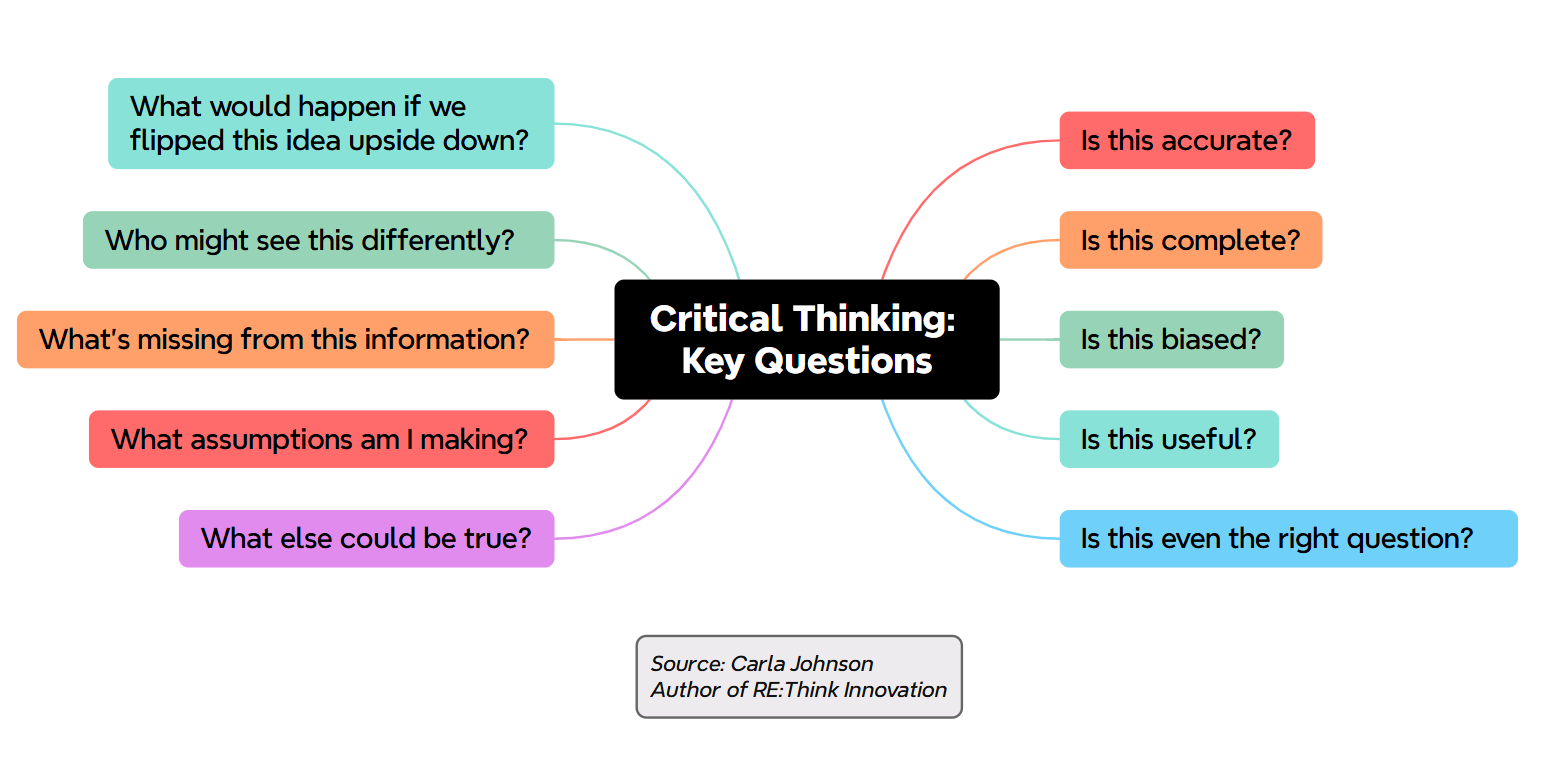
As you build the map, you’ll find that the visual format does something remarkable: it creates cognitive distance between you and your own thinking. You can see your reasoning as an outsider would — which makes it much easier to spot the places where you’re rationalizing rather than reasoning.
“After spending two decades studying how people solve complex problems, I’ve discovered that the most successful innovators pause and observe, question everything, and connect the dots across seemingly unrelated domains.”
– Carla Johnson, Innovation Architect
This is the kind of structured yet flexible analytical environment that no document or note-taking tool can replicate.
Mind mapping provides the ideal canvas for doing exactly that.
AI and critical thinking: A double-edged sword
Let’s talk about AI. Because you can’t have an honest conversation about critical thinking in 2025 without addressing it.
AI tools are remarkable. They can synthesize information at scale, surface patterns across vast datasets, and generate well-structured analyses in seconds. Used thoughtfully, they are a genuine augmentation of human intelligence.
But there’s a darker side that we need to stare in the face.
AI erodes critical thinking when we use it as an “easy button.” When you outsource your analysis to an AI tool without questioning its output, you are not thinking critically. You are abdicating. And over time, abdicating your thinking to AI is exactly like abdicating your fitness to a personal trainer who works out on your behalf: the capability atrophies, even if you feel like you’re getting results.
AI generates confident-sounding errors. This is perhaps its most insidious property. AI models can produce fluent, authoritative, detailed text on topics where they are simply wrong — a phenomenon known as hallucination. Without critical thinking, you have no defense against it.
AI reflects the biases in its training data. Every AI model is shaped by the data it was trained on — including its biases, blind spots, and implicit assumptions. Critical thinkers probe these. People who accept AI output uncritically inherit them.
AI homogenizes thinking. When millions of people ask the same AI the same questions and accept the same answers, intellectual diversity collapses. The result is a world full of technically competent thinking that is disturbingly similar, deeply conventional, and resistant to genuine innovation.
On the other hand, when AI is used as a thinking partner — not a thinking replacement — it can be genuinely powerful. You can use AI to challenge your assumptions by asking it to argue against your position. You can use it to surface information gaps by asking it what evidence would be needed to validate your hypothesis. You can use it to generate alternative perspectives you haven’t considered. And you can feed its output into a mind map where you can critically evaluate, refine, and integrate its contributions on your own terms.
The key distinction is this: you must be the thinker. AI is the research assistant.
The good news is that leading mind mapping tools are increasingly integrating AI in ways that augment rather than replace your critical thinking. Used intentionally, these features can significantly sharpen your analytical process.
Here are some of the most valuable AI-powered mind mapping features for critical thinkers:
AI brainstorming and idea generation. Several mind mapping tools now offer AI assistants that can generate related ideas, perspectives, or sub-topics based on your central theme. Used well, this helps you ensure you haven’t overlooked important angles in your thinking — not by replacing your thinking, but by prompting you to consider what’s missing.
Automatic summarization and synthesis. When you’re researching a complex topic, AI can help you distill large amounts of information into key points that you can then map, evaluate, and critically analyze. This saves time on information gathering, freeing you to focus on the higher-value work of evaluating and synthesizing.
Content import and structuring. AI features that can import research documents, web content, or other sources and automatically structure them into a mind map give you a powerful starting point for critical analysis — a visual scaffold you can interrogate, challenge, and rebuild according to your own thinking.
Pattern recognition across large maps. For large, complex mind maps with dozens of branches and sub-topics, AI analysis can surface thematic patterns or connections that might not be immediately obvious to the human eye — providing new angles for critical exploration.
The critical principle: Use these features to challenge and expand your thinking — not to outsource it. The visual, spatial nature of a mind map ensures that you remain the active evaluator and decision-maker, with AI serving as an analyst in your employ rather than as the author of your conclusions.
Your next move: Elevate your critical thinking — and your impact
Critical thinking is not a trait you either have or don’t have. It’s a skill — a discipline — that you build through practice, through the right tools, and through a genuine commitment to examining your own thinking with rigor and honesty.
If you want to start elevating your critical thinking skills today, here’s what I recommend:
- Make a mind map your default workspace for any decision, analysis, or evaluation that matters. Before you write a document or fill a slide deck, map the problem visually first.
- Put your core question at the center, not a topic. Questions drive critical thinking. Topics invite passive information-dumping.
- Force yourself to build branches for counterarguments, alternative explanations, and missing evidence. If you can’t articulate the strongest case against your position, you don’t understand it well enough yet.
- Use AI tools as thinking partners, not thinking replacements. Ask them to challenge your assumptions, surface counterarguments, and identify information gaps — then critically evaluate what they return
Practice metacognition. After completing a major analysis or decision, review your map and ask: Where did I assume instead of investigate? Where was I influenced by bias? What would I do differently?
What can you expect as a result? In my experience — and in the experience of the thousands of mind mapping practitioners I’ve observed over the years — the impact is both broad and deep.
You’ll make better decisions, because you’ll interrogate your assumptions before acting on them. You’ll solve harder problems, because you’ll see through surface-level symptoms to root causes. You’ll be more persuasive, because your arguments will be better reasoned. You’ll be more resilient to manipulation, because you’ll have the tools to question what you’re told. And you’ll be more valuable as a thinker — in your organization, in your community, and in your own life.
In a world where AI is commoditizing tactical intelligence, the ability to think critically and independently is becoming the most important competitive advantage a human being can possess.
Mind mapping is your sharpening stone.
Pick it up and get to work.
Leave a Reply