

You open your mind mapping software. You type your central topic. You press Enter.
And there it sits, a lonely little box surrounded by an ocean of white space.
The cursor blinks. You know what you want to think through. A product launch, a strategic plan, next quarter’s content, a tough decision. But suddenly you have no idea what the first branches should be. You type something, delete it, type something else. Ten minutes pass. Then twenty.
If that sounds familiar, you’ve experienced what I call mind mapper’s block.
It’s like writer’s block, with a twist
We’ve all felt writer’s block: that dreaded feeling of staring at a blank screen while your brain refuses to cooperate. Mind mapper’s block is its visual cousin, and in one way it’s worse.
A document at least gives you a first line to fill. A mind map can branch in any direction, which is supposed to be freeing. But when every direction is possible, it’s hard to choose any of them.
In more than 20 years of using and writing about mind mapping tools, I’ve watched this moment trip up countless new users. Many of them were smart, capable people who could clearly benefit from visual thinking. They just never got past that first blank screen.
The emotional cost nobody talks about
Mind mapper’s block isn’t just a productivity problem. It’s an emotional one, and that’s what makes it so sticky. Here’s what it tends to feel like:
- Dread. All that empty space feels less like an opportunity and more like a test you didn’t study for.
- Self-doubt. You’ve seen gorgeous, sprawling maps made by experienced users, and you wonder whether you have what it takes.
- Perfectionism. Because your first branches shape everything that follows, you feel they have to be perfect from the start. So you hesitate to commit to any of them.
- Fear of judgment. If colleagues will see your map, you worry it will reveal how disorganized your thinking feels.
- Quiet resignation. After a few false starts, you start to wonder whether your brain simply isn’t wired for visual thinking.
And then comes the most expensive symptom of all: you give up and retreat to a document or notetaking app, capturing your ideas in familiar linear form.
What giving up really costs you
That retreat comes with a price tag. In my 2024 Mind Mapping Tools Survey, users reported an average 35% productivity increase from their mind mapping tools. More than one in five said their tool saves them over 7 hours a week. Among expert users, that figure jumped to 41%. You can’t collect any of that payoff if you never get past the blank screen.
Even if you don’t quit, the block chips away at your week. Let’s say it costs you 20 minutes per map in staring, false starts and restructuring, and you make two maps a week. That’s about 30 hours a year, nearly four full working days, lost to the space between your central topic and your first branch.
Why it happens: nobody taught you about the foundation
The culprit is almost always the same: your first-level topics, the branches that radiate directly from your central topic.
Tony Buzan, who popularized mind mapping, called them “basic ordering ideas.” He believed they were critical, because they work like the chapters of a book. They divide what you want to say into logical groupings, and everything else in your map hangs from them.
They also do something sneakier: They define your map’s scope and limit it. Once your first-level topics are in place, your brain tends to see only what fits within them. Choose well, and the rest of the map practically builds itself. Choose poorly, and you either stall or end up with a map full of blind spots.
Yet most of us were never taught how to choose them. We were just handed a blank canvas and told to “start mapping.”
The fix: frameworks, not inspiration
Here’s the good news. You don’t need a flash of inspiration to get started. You need a framework, a simple way to slice your topic into its component pieces.
Take a product launch. Using a framework called Divisions, you might break it into its natural groupings: goals, target audience, messaging, marketing channels, timeline and budget. Just like that, you have six solid first-level topics, and each one practically begs for more detail.
But you could just as easily use Process to map the same launch as a sequence of steps: research, plan, build buzz, launch and follow up.
Same central topic, completely different map, and both are perfectly valid.

Introducing my new book: Overcome the Dread of the Empty Mind Map
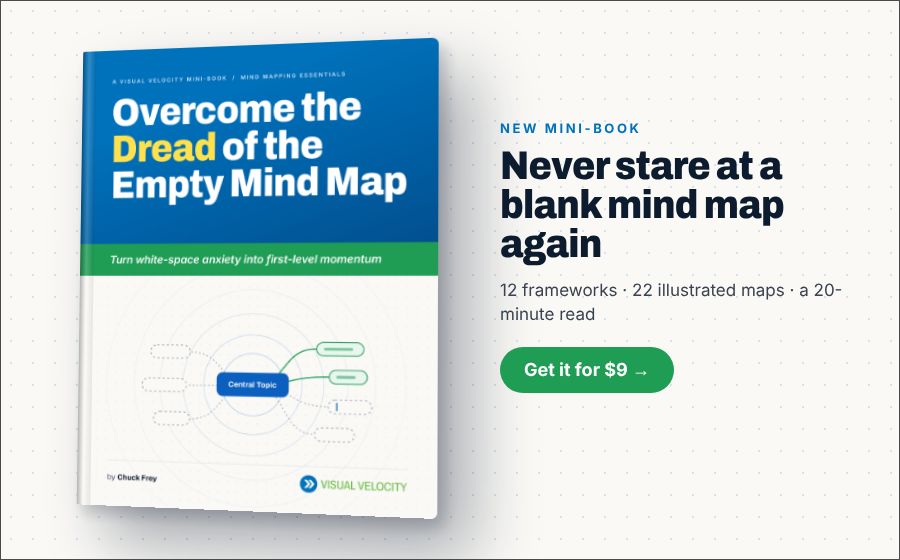
I’ve packed everything I know about building a strong foundation for your mind maps into a new mini-book: Overcome the Dread of the Empty Mind Map: Turn White-Space Anxiety into First-Level Momentum.
It’s a focused, 23-page read you can finish over a cup of coffee. Inside, you’ll find:
- 12 proven frameworks for choosing first-level topics, including 10 based on Buzan’s basic ordering ideas, each with real-world examples and its own illustrated mind map
- A quick-pick guide that matches your goal (plan, decide, explain, improve) to the right framework in seconds
- “One Topic, Many Maps,” which shows how six different frameworks structure the same product launch, and what each one reveals
- Answers to 11 common questions, like how many first-level topics you need, what to do when an idea fits under two branches, and how to use AI without letting it do your thinking for you
- 22 illustrated mind maps you can borrow as starting points
One of my favorite techniques in the book is for days when you’re truly stuck: work from the bottom up. I’ll show you how to turn a messy pile of floating ideas into a clean set of first-level topics in a few minutes.
Stop staring. Start mapping.
The next time you face a lonely central topic, you won’t have to wait for inspiration. You’ll reach for a framework, add three to seven first-level topics and feel the momentum carry you through the rest of your map.
Get Overcome the Dread of the Empty Mind Map for just $9 →
If it saves you a single 20-minute false start, it has paid for itself twice over. And you’ll never have to face that ocean of white space alone again.
P.S. If you’ve ever opened your mind mapping tool, stared at the screen and quietly gone back to a Word document, this book was written for you. Grab your copy here.
Leave a Reply