
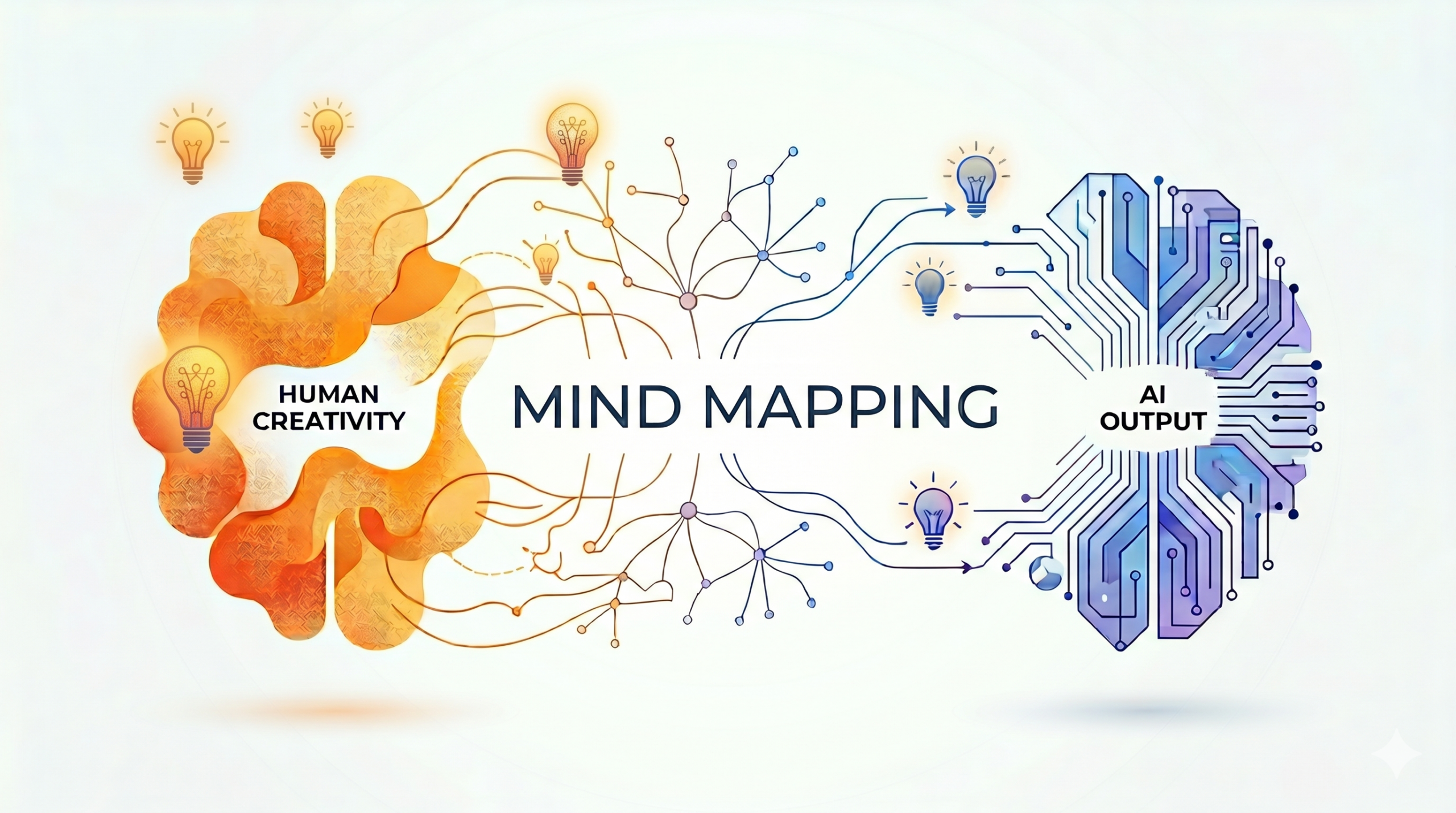
How mind mapping tools amplify what makes you uniquely you — and why surrendering your ideation to AI is a trap you must avoid
In a world increasingly dominated by the bland sameness of AI-generated ideas, it’s becoming more critical than ever for creators to leverage what makes them uniquely human to stand out.
One of the best ways to do that is to use tools that dovetail with our minds — tools that coax forth our best ideas and enable us to reflect upon and improve our thinking.
Mind mapping tools are uniquely designed to do exactly that. They serve as an extension of our minds and an amplifier for our thinking.
Why we need tools that help us nurture our ideas
Even if you use AI heavily in your work, you still need an environment in which you can nurture your ideas: distill them, expand them, and amplify them.
Traditional document-based tools are great for capturing linear blocks of text, including AI output. But they do very little to inspire us to nurture our ideas. The same goes for popular note-taking tools. They’re excellent containers, but poor seedbeds for growing what we’re thinking about.
Mind maps, in contrast, are designed to be both: a place to capture AND a place to grow your best ideas. They make it easy to do a brain dump of ideas, organize them and then grow little ideas into big ones.
7 ways mind maps make your thinking more human
In an increasingly AI-centric world, mind mapping helps you reclaim and amplify the qualities that make your thinking uniquely yours:
They support metacognition. Because your ideas are laid out visually in front of you, you can step back and think about your thinking — evaluating it, questioning it, and improving it on the fly.
They help you distill and synthesize. Whether the raw material came from your own marvelous creative brain or from an AI tool, a mind map gives you a workspace to compress sprawling information into the ideas that actually matter.
They support divergent thinking. A mind map is a flexible, low-friction workspace where you can explore many different paths of thought without being locked into a single linear narrative.
They invite personalization. Images, icons, colors, shapes, and other embellishments allow you to make your maps uniquely your own — the visual equivalent of a fingerprint.
They unleash the power of association. Your brain is wired to make connections. Mind maps give those connections a place to land, so you can explore your thoughts and ideas more deeply than if you were simply recording them in a document or on a piece of paper.
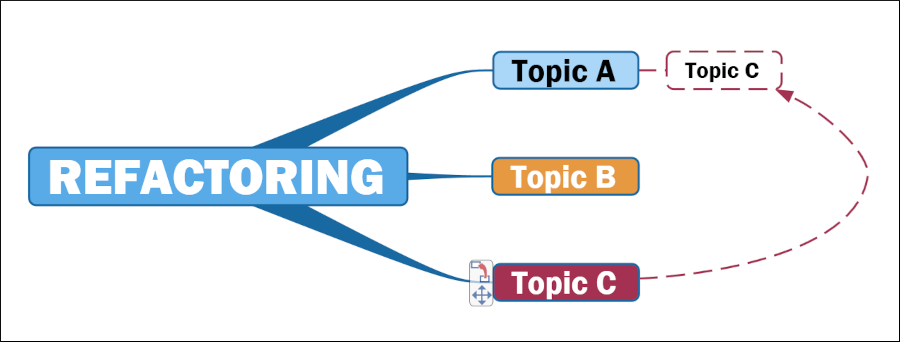
They surface hidden patterns. Because your ideas are recorded in an open, visual format, you can see relationships and patterns that would be invisible if your thinking were trapped inside paragraphs of linear text. This is enhanced by the ability to rearrange topics at will, enabling you to “refactor” them – or consider them within a new context.
They reveal what’s missing. When you’re thinking, planning, or organizing, a visual format makes it obvious what’s missing, what may be superfluous, and what needs to be strengthened. In a linear document, that structure is hidden inside sentences and paragraphs — you have to dig for it.
The power of association: a distinctly human superpower
Of all of these qualities, the power of association may be the most important. It’s something that makes us uniquely human, and it’s something AI cannot hope to duplicate.
When we encounter an idea, our brain immediately starts making connections from it. Sometimes these are logical extensions of the original concept. Other times, they’re bold, intuitive, or completely random leaps of thinking — the kind of leaps that can produce a breakthrough.
The open, visual format of a mind map creates fertile ground for these associations to take place. And once your brain has fired off an association, you can quickly capture it in your map and continue free thinking in whatever breadth and depth you wish.
Refactoring — the ability to rearrange the topics of your map and bring disparate ideas into close proximity to each other — further amplifies the opportunities for association. Two concepts that seemed unrelated may suddenly reveal a powerful connection when you place them side by side.
The risk of letting AI do your thinking for you
In today’s fast-changing world, it’s tempting to offload your thinking to powerful AI tools. After all, they can generate ideas in seconds that might take you minutes or hours to produce on your own.
But doing so carries a huge risk: your ideas and their expression will start to sound like everyone else’s, presented in the bland, nondescript lingua franca of AI output.
What’s needed are tools and frameworks that help to bring our humanity back to front and center — not push it to the periphery.
A blended approach beats the AI “easy button”
None of this is to suggest that AI has no role in idea generation. It absolutely does.
A smart, blended approach can be very productive. For example, you might brainstorm an initial set of ideas on your own — mind mapping them as you go — and then ask your favorite AI tool to build on those ideas or generate new ones based on the foundation you’ve already created. The map gives you a place to evaluate, refine, and integrate the AI’s contributions on your own terms.
What we must resist is the temptation to treat AI as the “easy button” — the sole brainstorming tool we reach for the moment a project lands on our desk. The bigger value lies in debating ideas that reflect our unique humanity and creativity, and in the act of shaping and improving them ourselves.
Human thinking shouldn’t be pushed to the periphery by AI. It should remain at the very center of our creative work — with mind maps serving as the visual canvas where that thinking can flourish.
Leave a Reply