
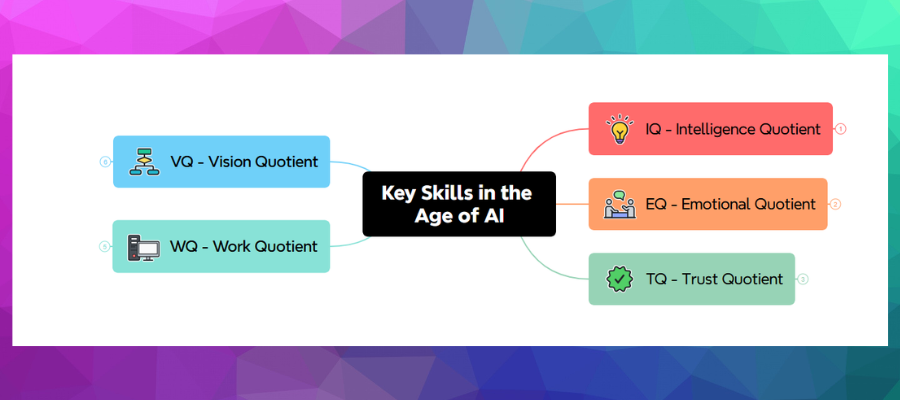
A landmark Fast Company article just named the human capacities AI can’t replace. Here’s how mind mapping develops every single one of them.
A Fast Company article published this week stopped me in my tracks.
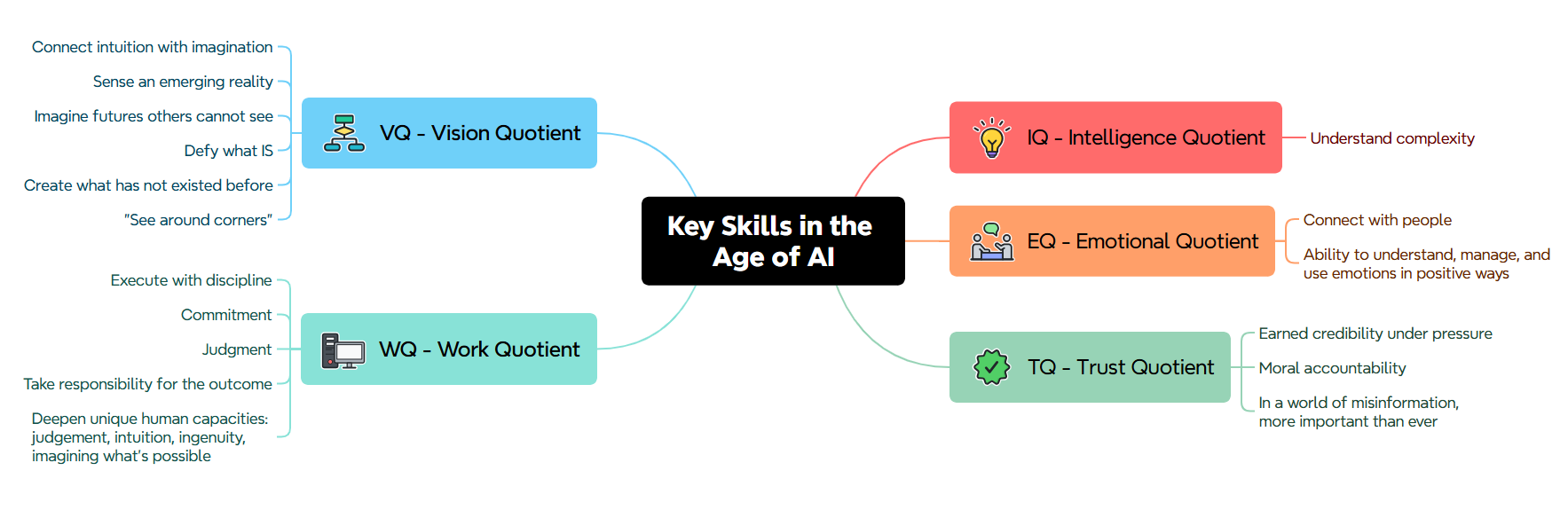
Written by Alan Fleischmann, founder and CEO of the global CEO advisory firm Laurel Strategies, it’s titled The Five Quotients: What Skills Will Matter Most in the Age of AI. The premise is deceptively simple: the future will belong to people who cultivate not just intelligence (IQ) and emotional intelligence (EQ), but three additional capacities that Fleischmann believes AI cannot meaningfully replicate — TQ (Trust Quotient), WQ (Work Quotient), and VQ (Vision Quotient).
It’s a genuinely important piece of thinking, and I encourage you to read it.
But here’s what struck me most: Fleischmann’s framework is a masterful answer to the question what we need to develop. What he doesn’t address — because it’s not his territory — is how.
That’s exactly where mind mapping enters the picture.
I want to argue something that I believe is true and underappreciated: mind mapping isn’t just a tool that supports these five capacities. Practiced deliberately and consistently, it’s a training ground for developing them. There’s a meaningful difference between using a hammer and becoming a skilled carpenter. The same distinction applies here. Let me take each quotient in turn.
(click the image below to view a larger version)
IQ: From information processing to architectural thinking
Fleischmann frames IQ as the capacity to understand complexity — the analytical and synthesizing intelligence that has always been prized in leaders and thinkers.
Here’s the problem: AI is now very, very good at processing information. If raw analytical horsepower is your primary edge, that edge is eroding.
The mind mapping practice that elevates IQ isn’t about processing more — it’s about thinking more structurally. Every time you build a map, you’re forced to make a decision that linear note-taking never requires: what is a branch, and what is a sub-branch? That seemingly simple act is hierarchical reasoning in practice. You’re not just recording ideas; you’re asserting relationships between them.
Do this regularly, and something interesting happens. You start to see those structures in problems before you open your mapping software. The practice of refactoring maps — rearranging branches, reconsidering how ideas relate — builds the habit of questioning your own first assumptions about how the world is organized. That is the kind of intelligence AI cannot optimize its way to.
EQ: Building empathy through deliberate perspective-taking
Emotional intelligence — the ability to genuinely understand and connect with other people — is one of the capacities Fleischmann says AI can simulate but not authentically possess. Machines can produce empathy-sounding language. That’s different from actually inhabiting someone else’s experience.
The mind mapping practice for EQ is specific and powerful: the empathy map. Before important conversations, negotiations, or decisions that affect others, build a dedicated map from their perspective. What are they worried about? What do they need that they haven’t said out loud? What pressures are they under that shape how they’ll hear your words?
This isn’t a warm-up exercise — it’s the practice of perspective-taking made visible and systematic. And what gets made visible gets developed.
The deeper practice is returning to these maps afterward. What did you miss? What did they actually need? Over time, this kind of reflective mapping builds the calibration that distinguishes genuinely empathetic leaders from those who are merely polite.
TQ: Creating a visual system for integrity
Of Fleischmann’s five quotients, TQ is perhaps the most demanding — and the most underestimated. He defines it not as likability or warmth, but as earned credibility under pressure. Trust is the confidence others place in you when the stakes are high and uncertainty is real. It’s built slowly and lost quickly.
What mind mapping practice builds this? I’d call it the commitment audit map.
This isn’t a to-do list. It’s a living visual record of what you’ve promised, to whom, and whether you followed through — including the uncomfortable entries. The practice of sitting with that map honestly, especially after you’ve fallen short of your own standards, is precisely the kind of self-reckoning that trust is built from.
No machine builds trust this way, because trust requires moral accountability — the willingness to look your own track record in the eye. That’s a human act. And a mind map makes it harder to look away.
WQ: Making the unglamorous work visible
Fleischmann’s description of the Work Quotient is one of the most honest things I’ve read about professional excellence in years. He defines it as the discipline to carry work all the way through to completion — long after the excitement of starting has worn off. Not hustle. Not optimization. Completion.
The mind mapping practice for WQ begins with treating your project map as a living document — one you return to repeatedly, adding the undramatic sub-tasks, the follow-ups, the finishing details that don’t make it into the initial brainstorm because they aren’t inspiring. Making that work visible makes it real. Real things get done.
But the deeper practice is what I’d call the resistance map: a dedicated branch in your project map where you honestly name the obstacles, excuses, and patterns of avoidance that pull you away from completion. Most people carry these patterns invisibly and wonder why they keep recurring. Making them explicit — naming them, looking at them — is the first step toward changing them.
Fleischmann notes that what distinguishes human work from machine work is judgment, ownership, and the willingness to take responsibility for an outcome rather than a task. A resistance map is how you practice ownership.
VQ: Training the vision muscle
This is where I think the practice potential is deepest, and where Fleischmann’s framework most directly intersects with everything I’ve been writing about on this blog.
Fleischmann calls VQ the most important quotient of all — the distinctly human capacity to perceive possibility before proof exists, to imagine futures that don’t yet exist and then summon the conviction to pursue them. He makes a point that I find both stunning and important: AI is trained on existing patterns and existing realities. Its outputs, however impressive, are extrapolations from what already is. Human vision, at its best, works by defying what is.
No algorithm envisioned democracy. No machine independently dreamed of flight. Humans did — without complete information, without consensus, and often in the face of active ridicule.
The mind mapping practice for VQ is what I’d call pre-evidence mapping: starting a map not from what you know, but from a “What if…?” at the center. What would be true if the conventional wisdom in your industry were wrong? What exists at the edge of your field that no one is paying attention to yet? What problem keeps being described as unsolvable, and what would have to be true for it not to be?
The practice of contrarian branching — deliberately taking a widely-held assumption and exploring what the opposite would mean — trains the brain to question consensus rather than extrapolate from it. Done regularly, this is how you develop the mental habit of seeing around corners.
And here is something I’ve written about before that takes on new significance in this context: the power of association. When you place two seemingly unrelated ideas in close proximity in a mind map and something sparks — that moment of unexpected connection is VQ in action. It’s the mechanism by which visionary thinking actually works. You’re not manufacturing insight. You’re creating the conditions for it to emerge.
The bigger picture: Divergent thinking is the engine behind all five
Step back and look at Fleischmann’s framework as a whole, and something important comes into focus.
Every one of these five quotients requires the ability to think differently — to see what others miss, to question what others accept, to imagine what others can’t yet picture. In other words, they all require divergent thinking. Not as a creativity technique. As a fundamental orientation toward the world.
This is the thread I’ve been pulling on throughout my work on this blog: in a world where AI can generate competent, convergent answers to almost any question at machine speed, the human advantage lies in asking questions that AI wouldn’t think to ask, making connections that consensus thinking would never form, and pursuing possibilities that the evidence hasn’t caught up to yet.
Fleischmann has given us an elegant taxonomy for why this matters. But the practice of developing it — the daily discipline of externalizing your thinking, questioning your assumptions, making unexpected connections, and seeing what’s missing — is exactly what mind mapping is designed to support.
He answered “what.” You already know the “how.”
A challenge for you
Pick one of the five quotients where you know you have room to grow. Just one.
Now design a mind mapping practice specifically for that quotient — not a one-time map, but a recurring practice. A map you’ll return to. A map that will show you your own patterns over time. A map that will make visible what you’d otherwise leave invisible.
The world is going to keep asking more of our distinctly human capacities. The people who develop those capacities deliberately — through practice, not just aspiration — are the ones who will matter most in the years ahead.
Your mind map is waiting.
Alan Fleischmann’s original article, “The Five Quotients: What Skills Will Matter Most in the Age of AI,” was published in Fast Company on May 14, 2026. I encourage you to read it in full.
Leave a Reply